

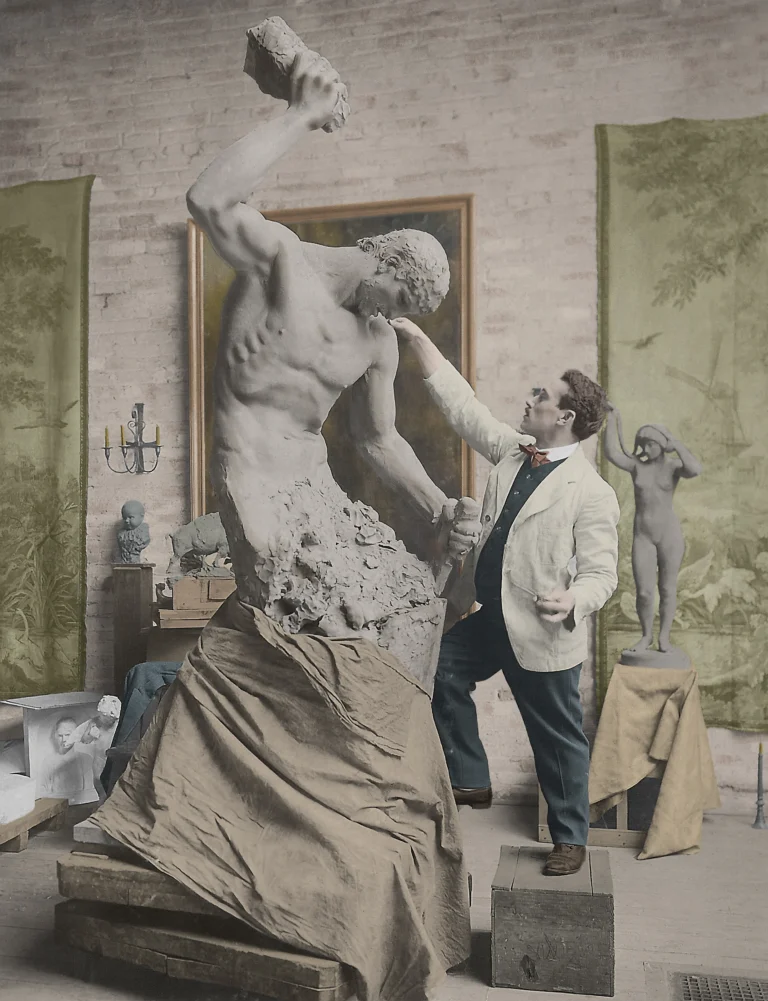
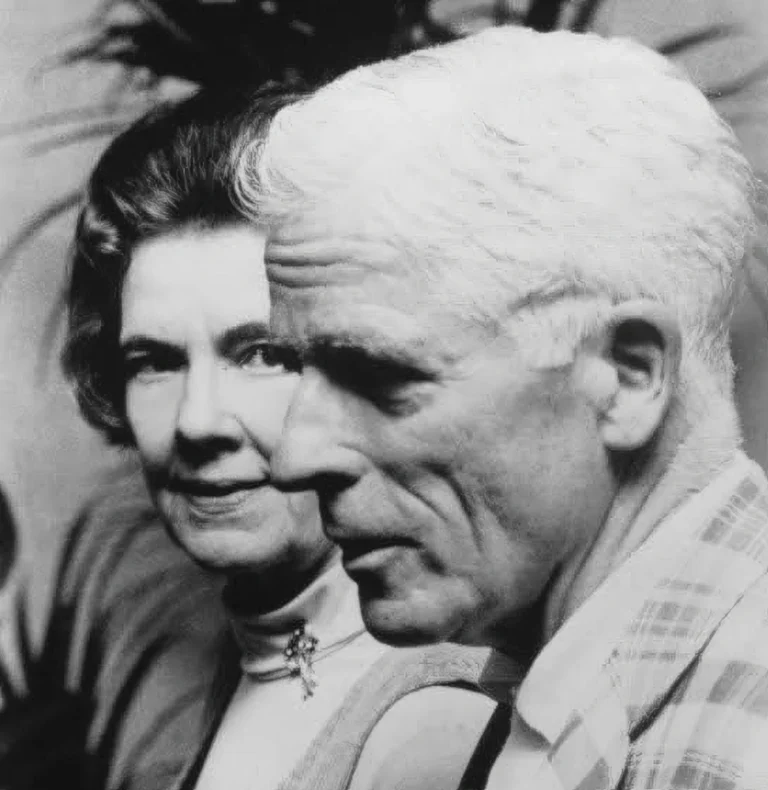
In this vintage photograph, sculptor Albin Polasek shapes one of his most famous works, Man Carving His Own Destiny. The museum that bears the artist’s name is celebrating its 65th anniversary this year.
Photo Restoration by Will Setzer at Circle 7 Studio
Birthdays
The Museum of Art – Deland
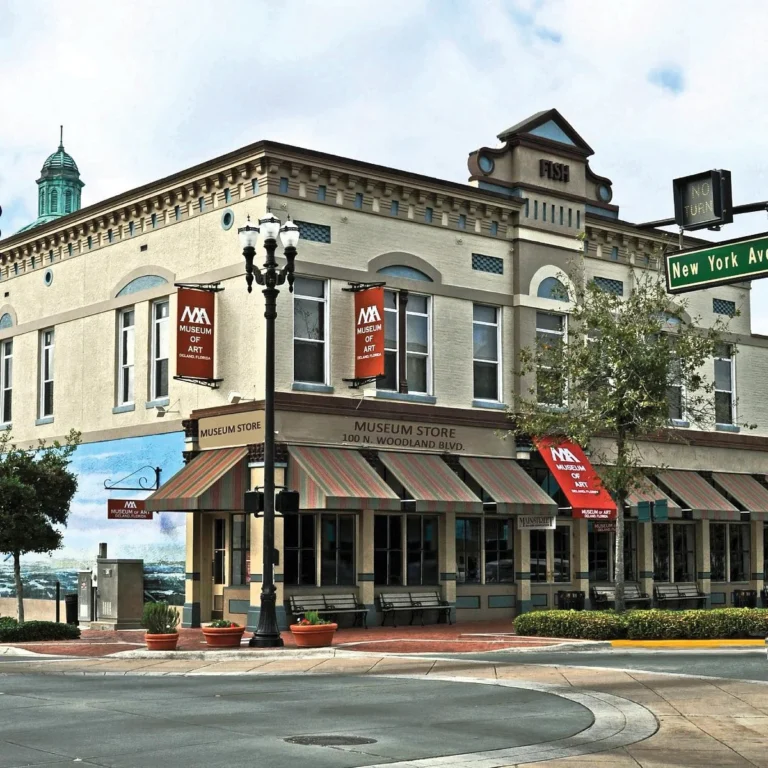
This year, the Museum of Art – DeLand marked its 75th anniversary with a yearlong series of activities and events that will culminate with a gala at it’s downtown location. The celebratory logo was designed by a current board member who attended art classes at the museum as a child. | Courtesy the Museum of Art – Deland
The Museum of Art – DeLand began as the DeLand Children’s Museum in 1951. It was the result of a grassroots effort led by the local chapter of the American Association of University Women to establish a dedicated space for learning, creativity and opportunity for young people in the small Volusia County town of about 8,600 residents.
Reincorporated in 1965 as the DeLand Museum and later the DeLand Museum of Art, the beloved institution—which adopted its current name in 2013—now serves some 80,000 people annually with a range of cultural experiences that include exhibitions, education, public art and outreach programs.
This year, the museum has marked its 75th anniversary with a yearlong series of activities and events that will culminate with a grand gala at its downtown location. The aptly titled Celebrate 75 Years of the Museum of Art – DeLand is slated for Thursday, September 24, from 6:30 to 9 p.m.
The commemorative event will include a dinner, a live auction and other special surprises. Further details had not been released at press time, but it’s safe to speculate that this will truly be a can’t miss happening.
“As we celebrate this milestone, we’re reminded that the museum has always been shaped by the people who have supported and believed in its mission,” says Martha Underriner, executive director. “As we look to the future, we remain committed to ensuring that art continues to inspire, educate and strengthen our community for generations to come.”
Further commemorating the milestone is an anniversary logo created by DeLand artist Erica Group Kiel, who attended summer camp at the museum as a child and today serves on its board of directors. Adds Underriner: “Having Erica design this meaningful symbol feels like a full-circle moment and a reflection of the relationships that have always defined the Museum of Art – Deland.”
The museum’s journey hasn’t always been without twists and turns. In 1991 the Cultural Arts Center was built to house the museum, the Sands Theater and the DeLand Little Symphony. Over time, however, other organizations moved on and the museum became sole steward of the complex.
Still, in 2013, the museum expanded by opening a satellite campus in the vibrant heart of Downtown DeLand. This move strengthened accessibility and introduced an eclectic museum gift shop that sells art-related items, home goods and unique gifts. The expense of maintaining two locations, however, strained the budget.
An investment group bought the Cultural Arts Center in 2025 with plans to redevelop it as a commercial center. That, in turn, allowed the museum to consolidate operations at its downtown location. Since then the operation has become stronger fiscally and an even more important cultural hub in West Volusia.
Located in the historic Miller Fish Building, the museum has 3,500 square feet of gallery space and enjoys visibility at the city’s busiest pedestrian and vehicular intersection. The storefront is at the epicenter of street festivals, quarterly art walks, downtown parades and pretty much any special events in the city.
But whatever the name or location, the museum across the decades has welcomed hundreds of thousands of residents and visitors and wowed art-lovers by featuring such internationally acclaimed creators as M.C. Escher, Carole Feuerman, Duane Hanson, John Mellencamp (yes, we mean that John Mellencamp) and Kirsty Mitchell.
“Today, the museum continues its mission through exceptional exhibitions, vibrant educational programs and community-centered events,” says Underriner. “Our reach extends far beyond gallery walls, connecting with thousands of people yearly through outreach initiatives—particularly programs serving children and families.”
The Museum of Art – DeLand is located at 100 North Woodland Boulevard, DeLand. For more information, call 386.734.4371 or visit moartdeland.org.
Florida Symphony Youth Orchestras
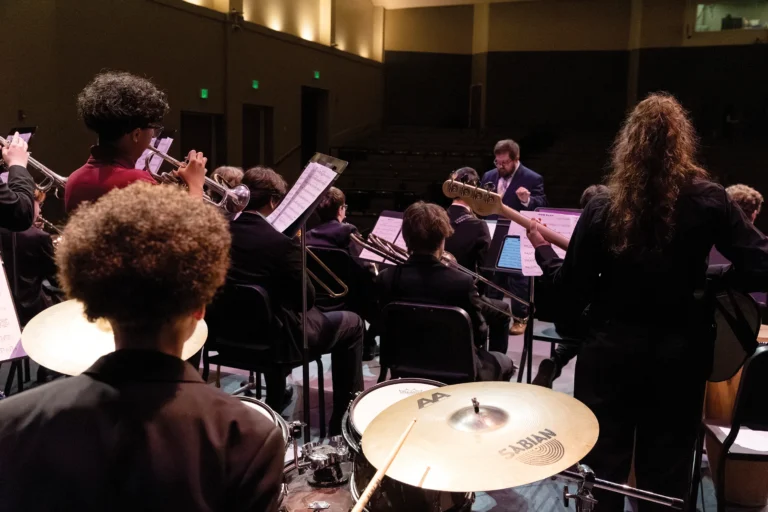
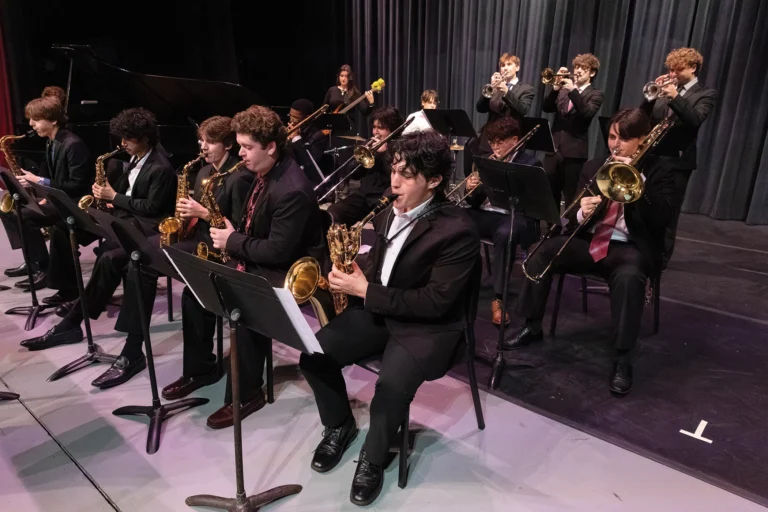
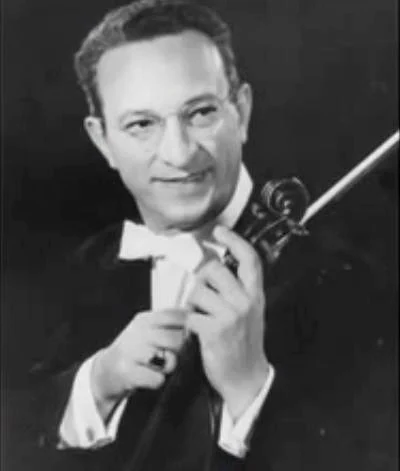
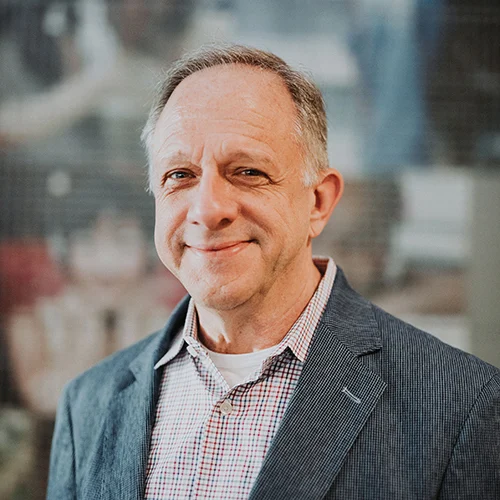
FSYO has two jazz bands, both named for important figures in the organization’s history: founding conductor Alphonse “Phonsie” Carlo, a professor at Rollins College, and Joseph Wise, director of transportation services for Orange County Schools who was music director from 1984 to 1993. | Courtesy Florida Symphony Youth Orchestras
Violinist Alphonse “Phonsie” Carlo, during an interview for a job at the Rollins College Conservatory of Music, was asked by President Hamilton Holt—a lover of music who had sung first tenor in the Yale Glee Club—if he knew an obscure Irish folk tune, “Londonderry Air.”
Carlo did indeed know the song and played it as Holt accompanied him on an old stand-up piano. Delighted, Holt offered Carlo a job as an assistant professor of music in 1943.
A student of the violin at Yale University and the Julliard School of Music, Carlo later helped organize the Bach Festival Orchestra and the Florida Symphony Orchestra—and served as concertmaster for both.
Then, in 1953, Carlo was recruited to teach violin for the Community Courses for Children, a program affiliated with Rollins. Shortly thereafter, he convinced the Orange County School Board and the Florida Symphony Orchestra that both would benefit from formation of a youth orchestra.
Schools could offer orchestral training without the expense of starting orchestral programs. The symphony could have players-in-waiting and an expanded base of support through the proud parents of the youngsters. As it turned out, the youth orchestra would outlast its professional counterpart, which ceased operation in 1993.
There were, however, immediate challenges. First and foremost, assembling a competent, much less a good, youth orchestra was no small feat in 1953, when music programs in most public schools were focused on brass-heavy marching bands. Still, Carlo believed that there were enough aspiring classical musicians in the region to make his idea work.
Announcements were made, an article was published in the local newspaper and on the first Saturday in November more than 100 students from middle school through high school, their instruments in tow, showed up at Howard Junior High School. It was a beginning.
On subsequent Saturdays, Carlo—with the help of local public-school music teachers and a handful of symphony players—offered free classes for beginning and intermediate players. These sessions were followed by rehearsals for advanced students, who formed the inaugural members of the Florida Symphony Youth Orchestra.
In 1957, the 30-member FSYO donned tuxes and gowns and played its first high-profile gig at the Florida Symphony Orchestra’s annual Spring Pops Concert at Orlando Municipal Auditorium.
Which is all an exceptionally long way of explaining why, although it was formed several years earlier, FSYO considers 2026–27 to be its 70th year and thus its Platinum Season.
The kids, of course, were a hit—and not just with their moms and dads.
“I’ve never seen a group of students with more self-discipline and more earnestness in their work,” said Edward Preodor, head of the violin department at the University of Florida in an interview with the Orlando Sentinel. “Dr. Carlo is obviously a musician who understands young people and who loves to work with them.”
The fledgling FSYO also performed solo concerts, including at least two that were televised locally. Carlo, who stepped down as conductor in 1960, remained a steady, supportive presence and continued to offer private lessons to orchestra members. This visionary pioneer of local classical music education died in 1992.
Today, FSYO serves more than 300 students and comprises a series of distinct ensembles: Overture Strings; Prelude Orchestra, Sinfonia Orchestra, Philharmonia Orchestra, Symphonic Orchestra and Percussion Ensemble.
There are also two jazz bands—both named for important figures in the organization’s history: founding conductor Carlo, naturally, and Joseph Wise, who was music director from 1984 to 1993. At the time, Wise was also director of transportation services for Orange County Schools.
FSYO Music Director Charles Watford, who spent 30 years as a high-school music educator and director of bands in Orange and Seminole counties, conducts the Symphony Orchestra and oversees a roster of other specialized conductors.
In 1989, FSYO’s Tour Orchestra—advanced musicians selected from the ensembles—premiered at Carnegie Hall in New York City under the direction of Wise. As FSYO began its 70th Season this past June, the Tour Orchestra returned to the storied venue for a third time—with a beaming Wise in the audience.
Meanwhile the Tour Jazz Band collaborated with clinicians at Jazz at Lincoln Center and made its New York City debut with a gig at The Jazz Gallery, a nonprofit venue that operates primarily as an incubator for young musicians and has helped launch successful performing careers.
Among FSYO’s other engagements this season are the St. Luke’s Concert Series, Saturday, October 10, at 2 p.m. at St. Luke’s Lutheran Church; and the Classical Opener, Sunday, October 11, at 3 p.m., at a venue to be announced.
The Jazz Opener is slated for Sunday, October 18, at 3 p.m. in Judson’s Live at Dr. Phillips Center. Both the Carlo and the Wise ensembles will perform, marking the first time a team of FSYO musicians has ever played in the sleek and sophisticated 150-seat listening room.
Then the orchestra will provide live music for Central Florida Ballet’s pyrotechnic A Christmas Nutcracker Tale on Wednesday, Thursday and Friday, November 18, 19 and 20. The venue hadn’t been finalized at press time but will likely be either Steinmetz Hall or Walt Disney Theater at Dr. Phillips Center.
FSYO’s annual holiday festival, Season’s Greetings from the Garden, will follow on Sunday, December 20 from 2 to 5 p.m. at Mead Botanical Garden in Winter Park. The event, which has a festival vibe, will feature food trucks, lawn games and musicians performing simultaneously across two outdoor stages: The Grove and Little Amphitheater.
Plans are afoot to wrap up the season in the Spring of 2027 with an anniversary concert in (drum roll, please) Steinmetz Hall at Dr. Phillips Center. FSYO musicians have appeared at the internationally acclaimed, acoustically pristine venue in supporting roles but never as headliners of their own show. Details had yet to be finalized at press time.
“There’s an air of excitement buzzing around FSYO, and I am honored to help commemorate our legacy through our commitment to musical excellence,” says Abigail Tran, executive director. “We’re not just honoring our history and legacy but also ensuring the longevity of FSYO.”
For more information, including auditions and scholarships (no student unable to pay tuition is turned away), call 407.999.7800 or visit fsyo.org.
Albin Polasek Museum & Sculpture Gardens
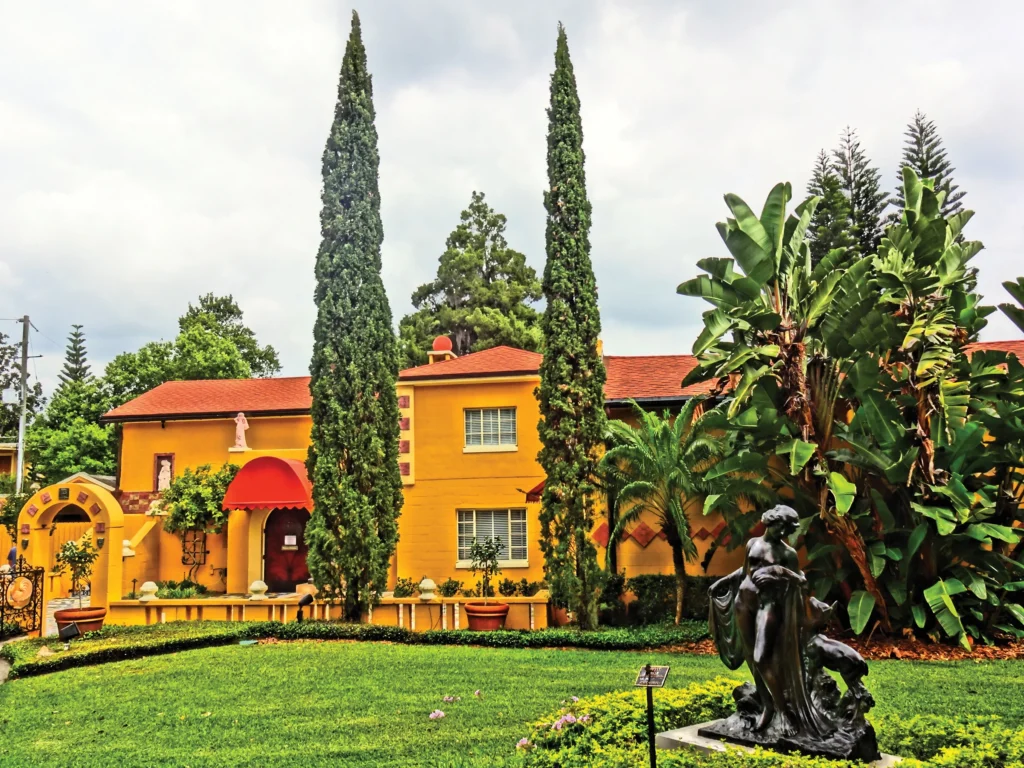

The lushly landscaped, 3.5-acre grounds of the one-of-a kind Albin Polasek Museum & Sculpture Gardens borders Lake Osceola in Winter Park—the view alone is worth the trip. So are the magnificent flowers and rare trees that serve as a backdrop for the breathtaking larger-than-life sculptures, such as The Sower, on permanent display. | Courtesy Albin Polasek Museum & Sculpture Gardens
The lushly landscaped, 3.5-acre grounds of the one-of-a-kind Albin Polasek Museum & Sculpture Gardens borders Lake Osceola in Winter Park—so the view alone is worth the trip. So are the magnificent flowers and rare trees that serve as a backdrop for the breathtaking larger-than-life sculptures on permanent display.
The Polasek, formerly the home and studio of renowned sculptor Albin Polasek, has been celebrating its 65th anniversary all year with a dynamic lineup of special exhibitions, intimate musical performances and community showcases. Among the commemorations will be a free, open-to-the-public event on Tuesday, November 17, from 5 to 7 p.m.
The gathering will feature cake and champagne, refreshments, raffle prizes, a commemorative anniversary giveaway and the debut of a special video that will highlight the museum’s fascinating (and at times improbable) history. Advance registration is encouraged.
Also marking the milestone will be an exhibition at the Winter Park Library through October and November. The eclectic display will feature sculptures and artwork by Polasek alongside archival photographs, documents and artifacts—some of which have never before been publicly exhibited.
Born in Moravia (now the Czech Republic), Polasek worked as an apprentice woodcarver in Vienna before immigrating at the age of 22 to the U.S., where he studied sculpture at the Pennsylvania Academy of the Fine Arts and for 30 years served as head of the sculpture department at the Art Institute of Chicago.
Meanwhile, he was crafting monumental works—his most famous and career-defining sculpture was Man Carving His Own Destiny (1908), although he also won international acclaim for The Sower (1911) and Victorious Christ (1920). His Woodrow Wilson Monument (1928), erected in Prague, celebrated the president’s role in securing the independence of Czechoslovakia.
Already world famous, Polasek retired to Winter Park in 1950, at age 70, and only added to his renown through his late-career work—which, under the circumstances, is all the more remarkable. Just months after his relocation, Polasek suffered a stroke that paralyzed the left side of his body.
But the health crisis didn’t defeat him; instead, he devised a method that enabled him to carry on by enrolling assistants to hold a chisel as he chipped away at blocks of stone with his unaffected right hand. Polasek doggedly completed 18 more sculptures prior to his death in 1965 despite being partially paralyzed and wheelchair bound.
In addition, the man who claimed to be a confirmed bachelor married twice while in Winter Park: first in 1950, shortly after his stroke, to Ruth Sherwood, a former student of his who had retired to the same city. Then, nine years after Sherwood’s untimely death, he returned to the altar with Emily Muska Kubat, the widow of a friend.
Today, the Albin Polasek Foundation owns and operates the sculptor’s historic Mediterranean-style estate. Polasek established the foundation himself to secure the property’s future as a vibrant cultural hub—a mission originally fulfilled by his second wife until her passing in 1988.
No doubt, the artist would be pleased at how it all turned out. The museum today attracts more than 30,000 visitors annually and is one of only two sites statewide that are part of the Historic Artists’ Homes and Studios program—a coalition of 93 workspaces used by influential American artists that were selected by the National Trust for Historic Preservation.
Also on the property is the Capen House at the Polasek, a historic home that previously stood across Lake Osceola and was rescued from demolition in 2014 following a grassroots fundraising campaign dubbed “Preservation Capen.”
The effort, which in addition to the museum involved Friends of Casa Feliz and the Winter Park Historical Association, raised $550,000 in six months to implement an audacious plan. Buyers of the property, who wanted to clear the site and build a new home for themselves, had agreed to donate the 200-ton structure to the museum—if preservationists could move it.
That herculean task was accomplished by Winter Park contractor Frank Roark, who figured out how to safely cut the home in half. Barges floated the Tudor Revival charmer across the lake, where it was carefully reassembled and renovated on museum grounds. It is now a community venue especially popular for weddings.
Although it’s synonymous with a legendary sculptor, the Polasek celebrates art in all genres under Executive Director Jennifer Deery and Curator Tamie Diener-Lafferty. For example, America the Beautiful: The Monumental Landscapes of Clyde Butcher, on view through December 6, showcases works by the photographer known as “The Ansel Adams of Florida.” (See page 48.)
The museum—which features quarterly rotating exhibitions—also hosts the Winter Park Paint Out, an annual event held in April that hosts plein air painters from across the country, and Czech Heritage Day, slated this year for Sunday, September 13.
Says Deery: “When I think back to stories of the early days when there was no air conditioning, the grounds were only open during certain months, there were no gallery shows and no Capen House, it’s exciting to now celebrate not only that history but our progress.”
Adds Diener-Lafferty: “It’s truly an honor to be part of the team that is carrying Polasek’s legacy forward and helping shape the museum’s future. My hope is that the Polasek will continue to inspire, educate and bring people together for the next 65 years and beyond.”
In a nod to America 250, visitors for the remainder of the year will see a sculpture relief by Polasek that was selected as the official souvenir medal of the 1926 Sesquicentennial International Exposition in Philadelphia. It was struck at the U.S. Mint and distributed to visitors as a keepsake of the country’s 150th anniversary.
More of Polasek’s creations are placed throughout the city, most notably Forest Idyl at Winter Park City Hall; the Emily Fountain in Central Park, which was named for (and is said to resemble) his second wife; and three bronze castings on long-term loan to the city at the Winter Park Library & Events Center.
The Polasek is located at 633 Osceola Avenue, Winter Park. For more information, call 407.647.6294 or visit polasek.org.
The Casa Feliz Historic Home Museum
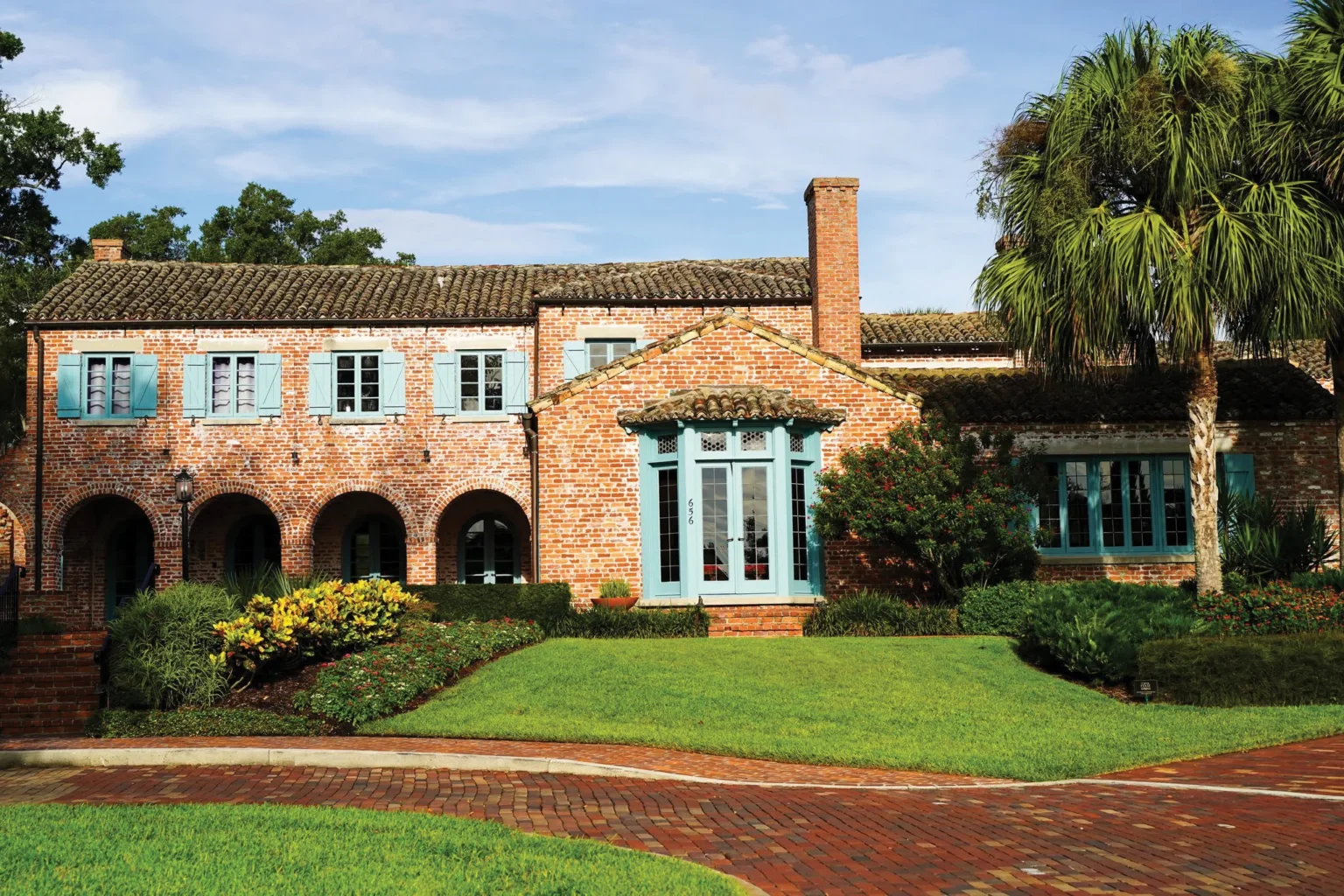
The Casa Feliz Historic Home Museum was transplanted to its current location in 2001, then painstakingly renovated and opened as a museum and community venue in 2005. The rescue came just in the nick of time.
A consortium of preservationists, under the auspices of a newly formed grassroots organization called Friends of Casa Feliz, jumped into action when a new owner began to raze the cherished landmark so that a modern mansion could be built in its place.
The group won a reprieve—aided by the discovery of a protected bald eagle’s nest on the property, which caused the demolition permit to be temporarily rescinded—and quickly raised more than $1.2 million from 400 individual donors.
Then, after the owners donated the house to the city on the condition that it be relocated, contractors used hydraulic structural moving dollies to roll the 750-ton building 300 yards across Interlachen Avenue to a lot next to the Winter Park Golf Course.
Restoration took several more years and was soon bolstered by a $250,000 grant from the state Division of Historical Resources. When the job was finished in the spring of 2025, just about the entire community—including doubters and naysayers who had opined that the project was sheer folly—turned out for grand opening ceremonies.
It seems like only yesterday but was, in fact, a quarter-century ago. Aptly, the anniversary year has been dubbed “Casa Feliz at 25: The House That Moved a City.” The milestone will be celebrated at a charmingly family friendly 25th Anniversary Community Day on Sunday, October 25, from 11 a.m. to 3 p.m.
Highlights of the free event will include an anniversary cake cutting and ice cream from Winter Park-based Kelly’s Homemade Ice Cream, which has created a special 25th anniversary flavor. A barbecue food truck will also be on site (from which food may be purchased) while the main stage will highlight bluegrass, jazz, and flamenco music and dancing.
The celebration will also feature a large-format display and the debut of a new short documentary video. Likewise, there’ll be plenty of activities for youngsters, including storytelling, souvenir crafting and bell ringing (yes, the house has an irresistible bell tower).
The unlikely backstory is certainly worth remembering. Architect James Gamble Rogers II, perhaps the city’s most significant architect, designed the Andalusian-style masonry farmhouse in 1932 for a private client, Massachusetts industrialist Robert Bruce Barbour. “Design it any way you like,” said Barbour. “If I don’t like it, I’ll sell it.”
Most of Rogers’s work at the time was inspired by traditional styles that he thought best suited Winter Park and its Old-World ambiance. While all of his buildings are community treasures, the Barbour House, as it was then known, was arguably his masterpiece.
And, most importantly, Barbour liked it. He and his wife, Nettie, hosted dozens of community gatherings at the home, which at 5,400 square feet was substantial but modest by today’s norms for grand estates. (The largest home Rogers ever built was the 7,000-square-foot Merrywood, also in Winter Park, which at press time appeared destined for demolition.)
Casa Feliz, which means “Happy House” in Spanish, became the epicenter of the social and cultural scene in Winter Park. The Barbours even hosted a high-profile, two-day fiesta for the Spanish Institute of Florida, headquartered at Rollins College, to honor legendary Spanish author Miguel de Cervantes (Don Quixote), who would have felt right at home there.
Following Barbour’s death in 1941, his wife remained in the house until she sold it in 1951. Multiple owners followed as property values soared and buyers came to see more value in the dirt than in the sometimes-quirky old structures that fronted the city’s brick-lined streets. Everybody knows how that story usually ends.
But, thankfully, not this time. Casa Feliz—owned by the city and operated by the Friends of Casa Feliz—is open three days a week for docent-led tours. The Music at the Casa series presents jazz and world music in an intimate setting, while the Parlor Series features presentations from historians, artists and other experts on a variety of topics.
Of course, there are also weddings—more than 2,500 to date with bookings far into the future. So, in just about every sense of the word, this is still a “happy house.”
“Casa Feliz is only here because a community decided that its architectural history mattered,” says Betsy Owens, the architect’s granddaughter and executive director of the nonprofit.
“Twenty-five years later, we want to celebrate not only the saving of the house, but the thousands of people who have passed through its doors and helped give it a vibrant second life.”
Casa Feliz is located at 656 North Park Avenue in Winter Park. For more information call 407.628.8200, extension 2, or visit casafeliz.us.
Blue Bamboo Center for the Arts
Courtesy Blue Bamboo Center for the Arts
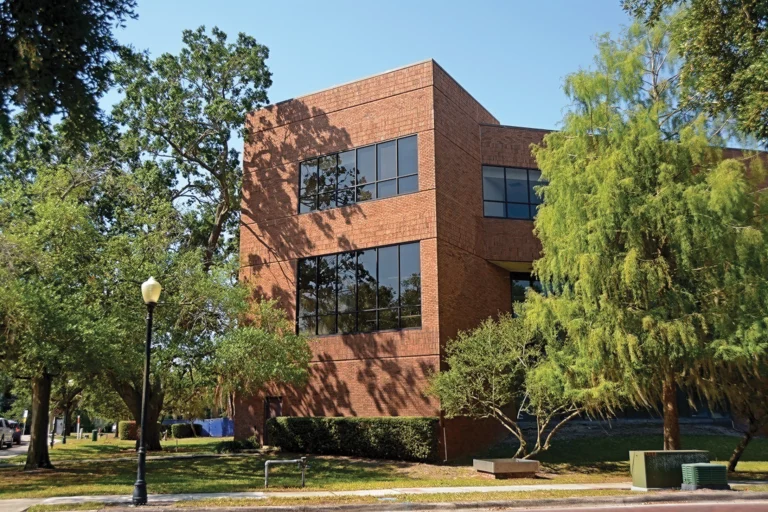
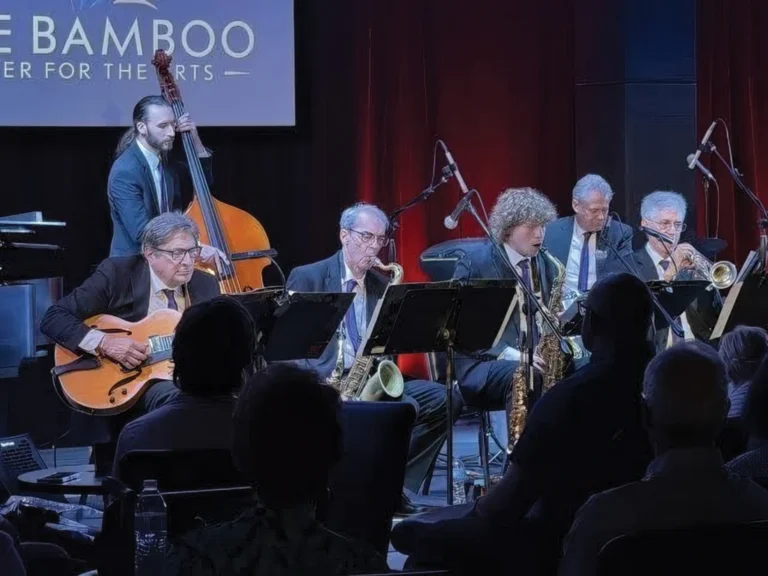
Blue Bamboo Center for the Arts, the little venue that could, started out in a small (and well-hidden) warehouse on Kentucky Avenue. But it celebrated its 10th anniversary this year at a state-of-the-art performance space on the first floor of the retrofitted former Winter Park Public Library. The headliner for the commemorative concert was the popular Orlando Jazz Orchestra.
“The Boo,” as the venue has long been known to fans, had settled into its new digs thanks to the commitment of savvy volunteers. It has defied the expectations of naysayers, who assumed that the nonprofit had bitten off more than it could chew when it secured a lease from the city for the three-story, 33,000-square-foot building.
Exacerbating matters was the tragic death of visionary founder Chris Cortez, who succumbed to brain cancer last year just six months after the new location opened its doors. Cortez, with his wife, the serendipitously named Melody, had envisioned the building as a vibrant arts hub with the venue on the first floor and other nonprofits on the second and third floors.
Cortez had managed to secure a $1 million cultural facilities grant from Orange County Arts and Cultural Affairs. And, backed by a high-octane board of directors and bolstered by an outpouring of support from fans, he had persuaded the city commission to support his concept despite competition for the property from Rollins College—which had sought to buy it outright.
Could The Boo survive without Cortez? Although he couldn’t have anticipated his illness, the founder had made certain that he had plenty of backup.
The board—which consisted of some newbies and some long-timers—had already helped shepherd the project through the roller-coaster processes of grant applications, construction permitting, budgeting and strategic planning. They had even provided volunteer labor when needed to help get the old building into shape.
Cortez’s dream, over time, had become their dream as well—and they weren’t about to give up on it now. They set about making certain that The Boo would survive and thrive for years to come.
“All of the tools for success had come together for The Boo,” says Jeff Flowers, chair of the board of directors. “The management team found its footing and joined with our donors to get the job done. I’m fully committed to this. We all are. Blue Bamboo is here to stay.”
But an additional bump in the road loomed and became problematic in June. Another arts organization had previously backed out of subleasing the second floor—which left The Boo facing a massive rent increase when its lease entered year two.
Try as it might, the organization—which was an unabashed success otherwise—had been unable to fill the vacant upper floor with another arts-oriented nonprofit as the lease had required. Yet, occupied or not, rent for the 11,000-square-foot space would come due in August.
Would the city help? Commissioners declined to offer a rent reduction or to accept an amendment to the lease that would allow the organization to offer the space to a commercial tenant. Consequently, board members were working on a backup second-floor concept as of early July. The proposed new approach will likely have been announced by the time you read this issue of Artistry.
During the first six months of this year, The Boo has hosted more than 200 events and attracted more than 15,000 audience members. Flowers notes that the venue is booked through the end of the year with acts that span musical genres.
He is particularly proud of the free “Thursday Night Hangs,” in which a squad of pros plays a set and then invites young musicians to join them in jam sessions. These events have typically drawn more than 100 school-aged players as well as spectators who love the creative vibe and the talent on display.
The Blue Bamboo Center for the Arts is located at 460 West New England Avenue, Winter Park. For more information and a schedule of events, visit bluebambooartcenter.com or call 407.636.9951.
Buildings
Knowles Memorial Chapel
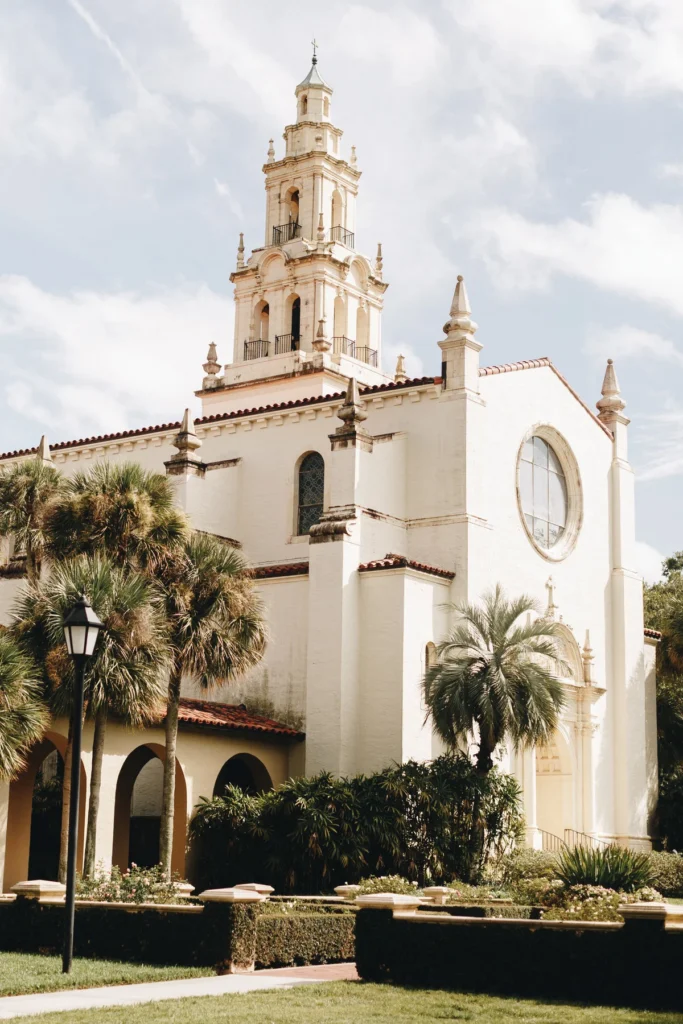
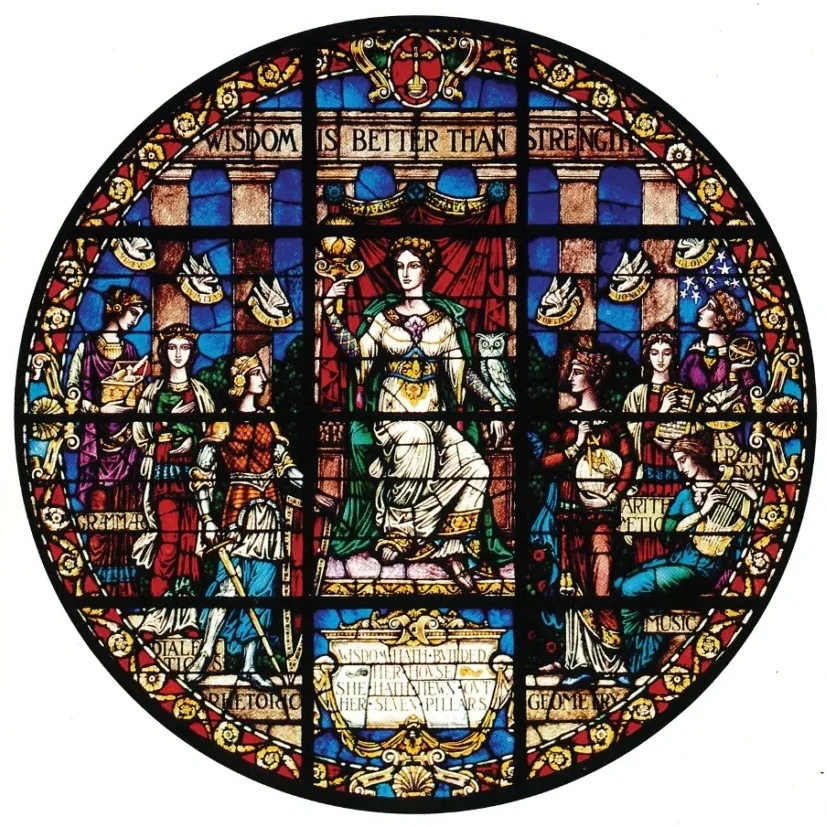
Knowles Memorial Chapel, designed by ecclesiastic architect Ralph Adams Cram, is as beautiful as ever but starting to show its age in places. It will be closed for as long as 18 months beginning next May for cosmetic and structural repairs and remediation. The chapel’s famous rose window, which can be seen above the front entry, highlights the Renaissance version of the seven liberal arts: wisdom, understanding, counsel, fortitude, knowledge, piety and fear of the Lord. | Courtesy Knowles Memorial Chapel
Rollins College ranks among the country’s most beautiful college campuses for reasons that are obvious to anyone who has ever seen it. Certainly, one reason why is Knowles Memorial Chapel, designed by famed ecclesiastical architect Ralph Adams Cram and built in 1932.
The Mediterranean Revival-style building, which is listed on the National Register of Historic Places, is the campus’s most iconic landmark and is home to worship services as well as guest speakers and musical performances—most notably those by the Bach Festival Society of Winter Park. It’s also among the region’s most popular wedding venues.
Beautiful as it remains, however, the nondenominational chapel is 94 years old and past due for a major makeover. So, the college has recently announced that the building will be closed for as long as 18 months beginning next May for cosmetic and structural repairs and remediation.
Lauren Bradley, assistant vice president for communications, says that the project will include roof and masonry restoration as well as stained-glass window conservation. Less visible but equally important will be mechanical, electrical, plumbing and air-conditioning upgrades as well as accessibility improvements.
Although the massive internal pipe organ has been overhauled twice, most recently in 2002, and the masonry was cleaned and restored in 2007, this will be the most comprehensive restoration effort ever undertaken in the chapel’s history.
Bradley notes that, since the scope of work hasn’t been completed, the total cost of the project is not yet known. She adds that the college will apply for a grant from the Florida Historical Commission, a panel that evaluates and ranks preservation proposals for the state’s Division of Historical Resources.
“Knowles Memorial Chapel has been one of the most significant and iconic landmarks on our campus for nearly a century,” says Brooke Barnett, the college’s president. “Preserving and restoring it is among our highest priorities, so future generations can enjoy it for the next hundred years.”
The chapel was donated to the college by Frances Knowles Warren in memory of her father, Francis Bangs Knowles, an industrialist and winter resident who was an important donor during the formation of the college and remained on its board of trustees until his death in 1890.
Hamilton Holt, college president from 1925 to 1949, added 32 buildings to the campus during his long tenure but considered the chapel to be his crown jewel. Something of a publicity hound, he awarded countless honorary degrees in that lofty space to a parade of high-profile luminaries including two presidents: Franklin D. Roosevelt and Harry S. Truman.
Have a look inside while you still can. Although there are not formal tours available, the chapel is open on Sunday mornings for worship services and during community events and musical programs. It is located on the campus at 1000 Holt Avenue, Winter Park. For more information, visit rollins.edu/chapel.
The Rollins Museum of Art and the Alfond Inn
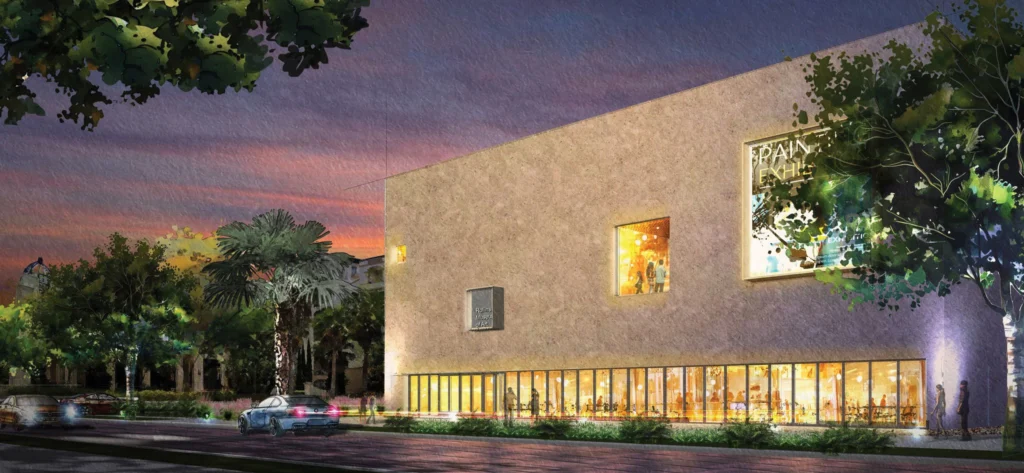
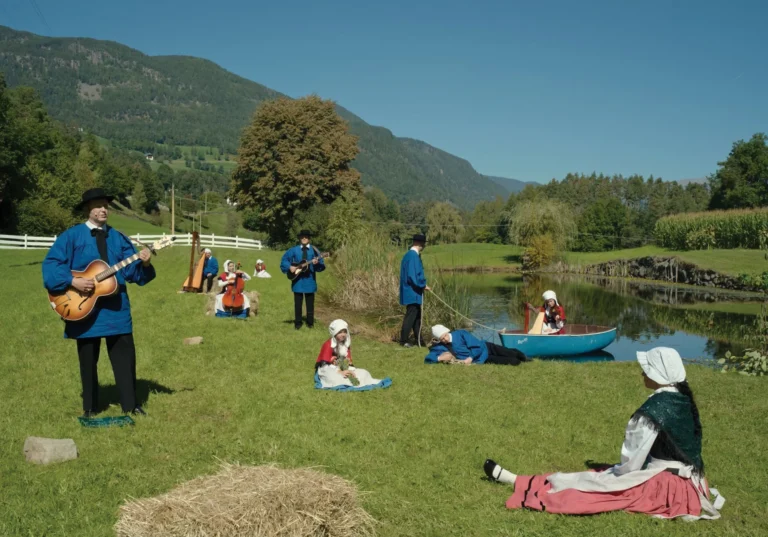
The new facility for the Rollins Museum of Art will not only increase space but also allow the museum to become a collaborator with artists and to commission and display new works. One of the most intriguing new works on view will be Icelandic artist Ragnar Kjartansson’s Sunday Without Love, an oddly compelling 2025 video installation that erases the boundaries between filmmaking, music and performance art. | Courtesy Rollins Museum of Art
The Rollins Museum of Art is creating a transformative new home that will be part of the college’s emerging Innovation Triangle—a bustling hub of kinetic energy in downtown Winter Park.
Described by Rollins College as “an integrated destination for arts, leadership education and hospitality,” the Innovation Triangle will also include the Rick Goings Institute for Management & Creative Leadership, set to open next summer, and the Alfond Inn, which opened in 2013 and was expanded in 2024.
The new buildings in the cross-disciplinary cluster are rising on a 2.37-acre city block owned by the college and bounded by New England, Interlachen, Lyman and Knowles avenues. Redevelopment of the tract, which was previously known as the Lawrence Center, was approved by the city commission in 2023.
Designed by architects Frederick Fisher & Partners, based in Los Angeles and New York City, the 32,000-square-foot museum—a sleek structure more than three times the size of the current on-campus facility—is slated to open its doors in early 2027 across the street from the Alfond and adjacent to the Institute.
The additional space will allow for displays of a wider range of art, says Leslie Anne Anderson, who was hired last year as executive director of the museum—which boasts an extensive collection of around 6,000 works that range from the pre-modern era through provocative contemporary art and even some Old Masters.
The new facility—which was paid for by fundraising and a $10 million grant from Orange County’s Tourist Development Tax—will also allow the museum to become a collaborator with artists and to commission and display new works. One example will be a mural by Judy Ledgerwood, an abstract painter and professor emerita of art theory at Northwestern University.
Ledgerwood’s work—inspired by architectural ornamentation—will be painted on the wall of the museum’s north lobby. The artist will attend a preview event of her site-specific creation for museum patrons in September. Everyone else will get to see it—and the new facility’s first exhibition, With Love, Rollins Museum of Art—in January of next year assuming the facility is complete.
Among the existing synergies inherent in the Innovation Triangle is the partnership between the museum and the Alfond Inn—the construction and renovation of which was supported by $42.5 million in grants from the Harold Alfond Foundation, established by the late Harold Alfond.
Ted Alfond, a son of Harold and trustee of his foundation, and Barbara Lawrence Alfond, Ted’s wife, are 1968 graduates of Rollins and supporters in their own right of the college and the hotel.
One way they have shown their support is through the establishment of the Alfond Collection of Contemporary Art, which was donated to the college and incorporated into the holdings of the museum. Roughly 140 of the global collection’s 600-plus pieces now adorn the art-centric inn’s public spaces.
The works on display deal with such topics as war, censorship, critical thinking and relationships between cultures and religious traditions. There are prints, paintings and photographs, mixed-media and neon works—as well as many pieces in which words alone convey the message.
Anderson says the Alfond will continue to exhibit contemporary art from the ever-growing repository. “The new location makes our relationship stronger than ever,” she adds, noting that with so many pieces from which to draw, there’s plenty of thought-provoking art for both locations to display.
With Love, in fact, will display a newly acquired piece from the contemporary art repository: Icelandic artist Ragnar Kjartansson’s Sunday Without Love, an oddly compelling 2025 video installation that erases the boundaries between filmmaking, music and performance art. It will be shown in a new, state-of-the-art projection gallery.
Also on view will be large-scale paintings by Nicolas Lancret and Alex Katz, masters of figurative art from different countries and different eras who drew inspiration from social gatherings of the fashionable elite. Lancret documented frolicking among 18th century French aristocrats, while Katz turned his attention to sophisticated 20th century New Yorkers.
Plus, the old museum won’t close, as you might expect it would, while it packs up to move. During the transition, visitors will have access to collaborations with artists Anne-Karin Furunes and Lilian Garcia-Roig, who will reimagine current galleries with large-scale installations.
Says Anderson: “If the ultimate goal of a new museum is to grow audiences and deepen engagement, then even temporary closure must be scrutinized and avoided.”
A native of Winter Haven in Polk County, Anderson has enjoyed a 20-year career in museums that included a six-year stint as chief curator of collections, exhibitions and programs at the National Nordic Museum in Seattle—where the novel multisensory exhibitions that she staged were praised in The New York Times.
She earned bachelor’s and master’s degrees in art history from the University of Florida, a master’s degree in the philosophy of art history from the CUNY Graduate Center in New York City—where she was Fulbright Scholar and conducted research at the University of Copenhagen—and an MBA from Emory University’s Goizueta School of Business in Atlanta.
In 2023, Anderson was honored by the University of Florida Alumni Association as one of its “40 Under 40” for her achievements as “a world-renowned curator, event coordinator, writer and teacher.”
Anderson has also recently been accepted as a member of the Association of Art Museum Directors (AAMD) and is currently the only AAMD member leading an art museum in Central Florida.
The Rollins Museum of Art is, for a while yet, still located at 1000 Holt Avenue, on the campus of Rollins College. For more information, call 407.646.2526 or visit rollins.edu/rma. The Alfond Inn is located at 300 East New England Avenue, Winter Park. For more information, call 407.646.2526 or visit thealfondinn.com.
The Charles Hosmer Morse Museum of American Art
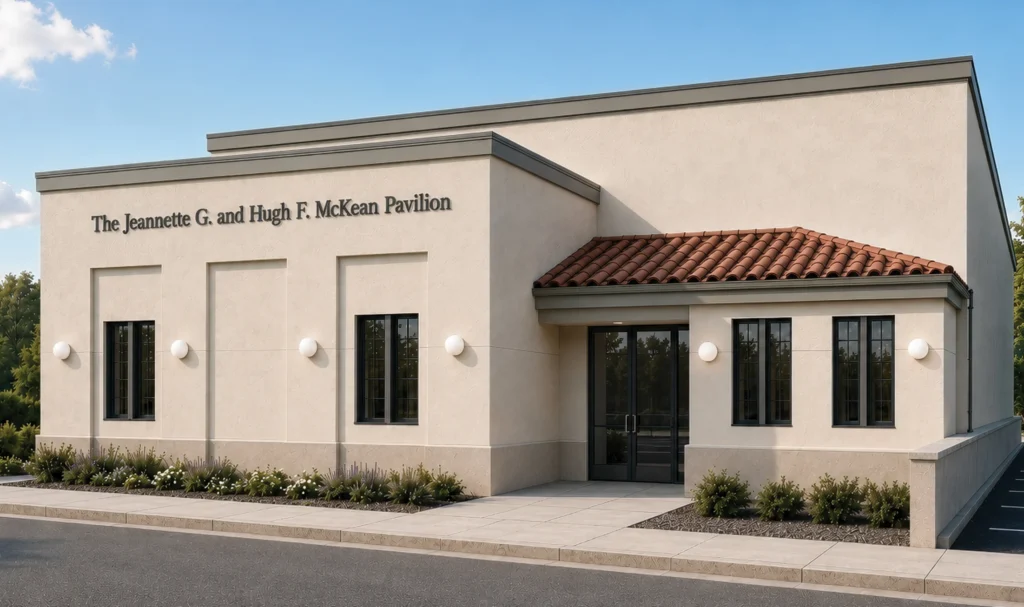
The Charles Hosmer Morse Museum of American Art has begun construction of a brand-new Jeannette G. and Hugh F. McKean Pavilion, which will expand the former space dedicated to educational programming and museum events. Because of advances in technology and heavier use, the new pavilion will better support the evolving needs of the museum and its audiences. The McKeans were major cultural forces in Winter Park. | Courtesy the Charles Hosmer Morse Museum of American Art
The Charles Hosmer Morse Museum of American Art—best known for its priceless collection of leaded-glass creations by Louis Comfort Tiffany—has begun construction of a brand-new Jeannette G. and Hugh F. McKean Pavilion. The project will expand space dedicated to educational programming and museum events.
Located just behind the museum’s facility on Park Avenue in Winter Park, the previous pavilion had served as the museum’s programming space since 1995.
That’s when a former bank building was adapted to house the vast collection of community icons Hugh F. McKean, an artist and former president of Rollins College, and Jeannette Genius McKean, an interior designer and granddaughter of museum namesake Charles Hosmer Morse, a Chicago industrialist and snowbird who retired to Winter Park and dedicated himself to its development.
Following decades of expanded programming and advances in technology, the new pavilion—designed by Winter Park architects Susan C. Gantt and Edmund P. Gantt—will better support the evolving needs of the museum and its audiences. Work, which began in June, is expected to take at least a year to complete.
The pavilion, a separate building that will mirror the visual vibe of the adjacent museum—not surprising since it, too, was designed by the Gantts—will add about 3,000 square feet while remaining within the former structure’s footprint.
“The previous building was never designed for the way we use it today, and that presents challenges,” says Jennifer Thalheimer, director and chief curator. “While we’re sad to see this building go, the new pavilion will provide greater flexibility and help streamline our staff’s work.”
As is the case with many cultural institutions in Winter Park, the Morse has a backstory that might have been conjured up in Hollywood—but perhaps dismissed by potential producers as too implausible.
As a young man, Hugh McKean had studied with Tiffany at the artist’s lavishly appointed, 84-room Long Island country estate, Laurelton Hall. Following Tiffany’s death in 1933, the estate fell into disrepair and was further damaged by fire in 1957. By then, Tiffany’s work had fallen so far from favor that the now-priceless creations were thought to be of little value.
The McKeans vehemently disagreed. Using a small fleet of rented moving vans, they transported what would become the core of their collection to a maintenance shed near their local estate, Wind Song, and displayed assorted pieces in the Morse Gallery of Art—which was founded by Jeannette and curated by Hugh—on the campus of Rollins College.
In 1977, the gallery moved off-campus to a 6,000-square-foot repository on East Welbourne Avenue and two years later changed its name to the Charles Hosmer Morse Museum of American Art. But still, very little of Tiffany’s trove of jewelry, pottery, paintings, art glass and leaded-glass lamps and windows could be displayed at any given time.
Then, in 1993, the city rejected Hugh McKean’s proposal to build a $29 million museum on the site of the Winter Park Golf Course, which undulated across 24.6 acres of land that had been inherited by Jeannette—who died in 1989. The land was now owned by the Elizabeth Morse Genius Foundation, named for Jeannette’s mother.
Thankfully, a task force led by then-Mayor David Johnson identified a site on Park Avenue—the adjacent Fosgate and SunBank buildings—that could be transformed into a museum where the collection could be properly displayed. All parties agreed, and the foundations purchased the buildings in 1993 for $1.5 million. (The city bought the golf course for $8.1 million in 1996.)
McKean, despite battling illness, remained intimately involved in every aspect of the project’s design and construction and died just months prior to the 16,000-square-foot facility’s grand opening. Near the end, he had refused his doctor’s offer of pain medication so that his focus on the task at hand could remain sharp.
“I never said that Jeannette and I had to live to see this,” an ailing McKean told the Orlando Sentinel as completion neared. The important thing, he added, was that the wonders within its walls could be shared with the community for generations to come.
The museum continues to be owned and operated by the Charles Hosmer Morse Foundation, with additional support from the Elizabeth Morse Genius Foundation. Consequently, the museum—sometimes cited as the biggest tourist draw in Winter Park—accepts no government funding.
In addition to housing the world’s most comprehensive collection of works by Tiffany—including the shimmering Byzantine-Romanesque chapel interior that he designed for the 1893 World’s Columbian Exposition in Chicago—the museum’s holdings encompass a vast collection of late 19th- and early 20th-century paintings and other works such as pottery and jewelry.
The Morse is located at 445 North Park Avenue, Winter Park. For information, call 407.645.5311 or visit morsemuseum.org..
Art & History Museums of Maitland
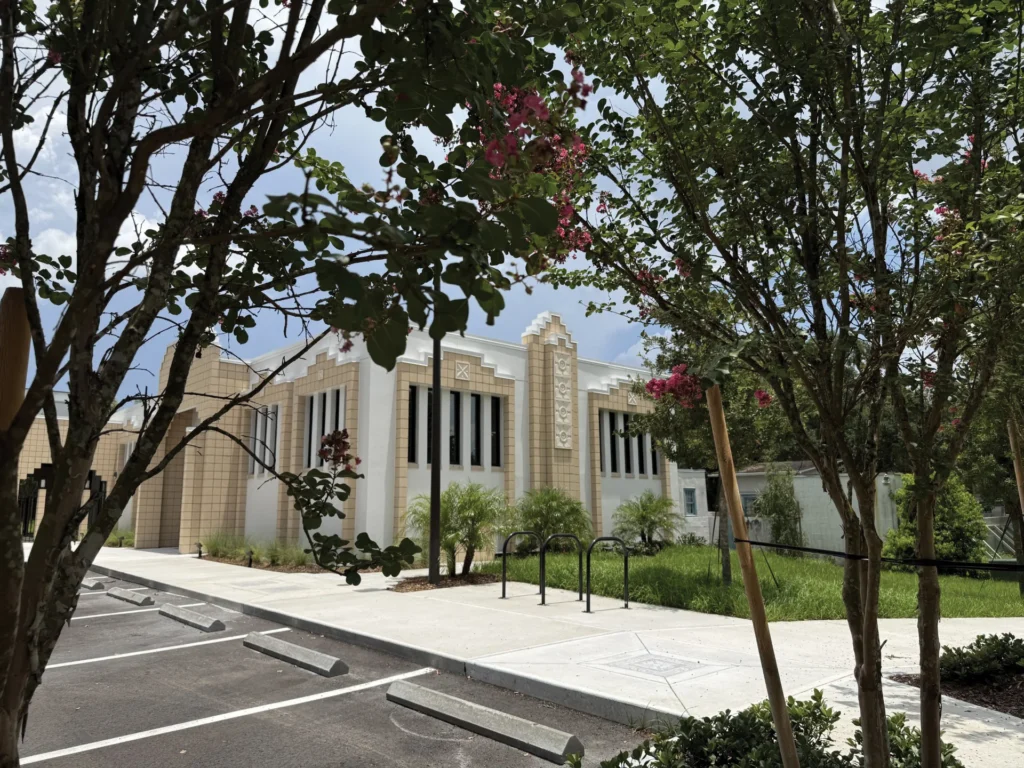
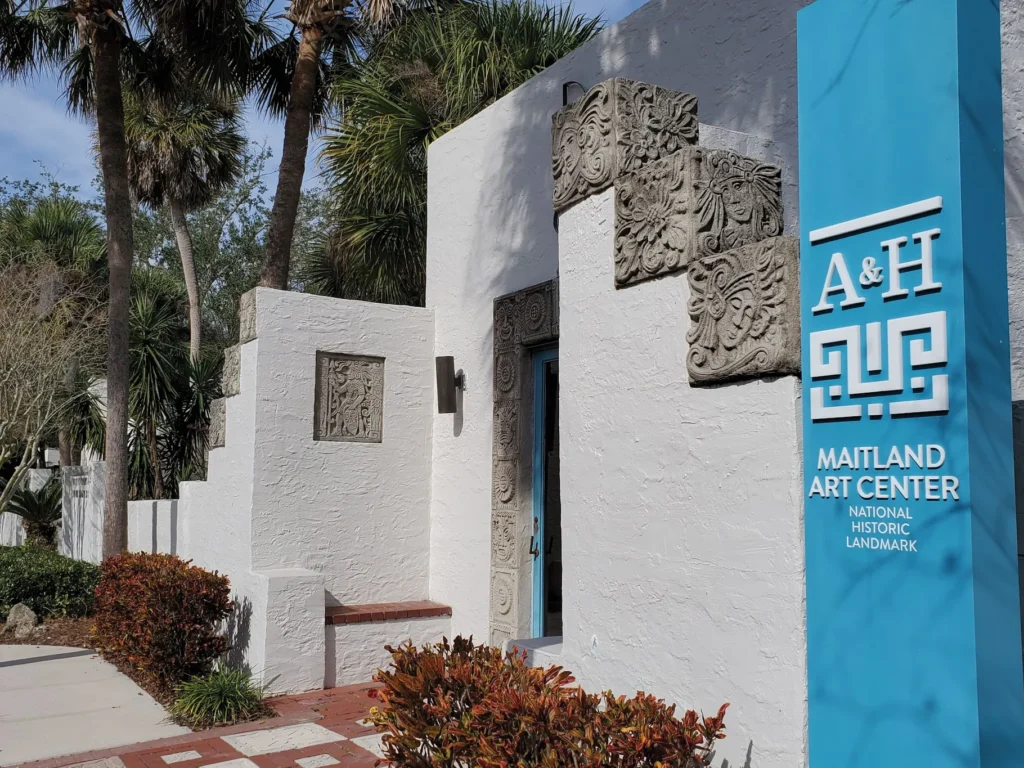
The expansion by Art & History Museums of Maitland (A&H)—a nonprofit umbrella organization that manages five distinct venues—will allow the other-worldly Maitland Art Center’s Mayan-revival campus on Packwood Avenue to double enrollment in its art classes and to reclaim diverted studio space for working artists. The expansion’s ripple effect will profoundly impact A&H across all of its venues. | Courtesy Maitland Art Center
To plot its course for the future, the Maitland Art Center only had to look to its past. A $3.4 million project has added two new buildings to the campus, one that expands the museum’s ceramics program and another that features three flexible classroom spaces.
The expansion by Art & History Museums of Maitland (A&H)—a nonprofit umbrella organization that manages five distinct venues—will allow the other-worldly center’s Mayan-revival campus on Packwood Avenue to double enrollment in its art classes and to reclaim diverted studio space for working artists.
Such an outcome would surely have pleased J. André Smith, the visionary painter, printmaker, sculptor and architect who, with the patronage of Lake Wales philanthropist Mary Louise Bok, began construction in 1937 on what he believed would be an artists’ colony.
Smith first dubbed his seemingly quixotic project “Espero,” which means “I hope” or “I wait” in Spanish. Now, the first significant expansion in 90 years extends the center’s footprint to Jackson Street along the south shore of Lake Sybelia.
The new buildings, which total 4,938 square feet, are called The Que Throm and Cicero Greathouse Education Studios. Sitting on a previously vacant 1.16-acre parcel on the west side of the property, they also encompass a gallery to highlight the work of Throm and Greathouse, among others.
“This expansion brings André Smith’s vision of a living, evolving artist retreat into the 21st century,” says A&H Executive Director Danielle Thomas. “It allows us to modernize and grow our art school, while also restoring the historic campus to its original purpose.”
Throm, who died in 2022, was a lifelong educator, a founding faculty member of Valencia College’s visual arts department and a member of the board of directors of A&H. Greathouse, who died in 2019, was a celebrated Disney Imagineer and maintained a studio at the center as part of its“Artists in Action,” its storied residency program.
The couple’s dedication to this magical place culminated in a major gift through their estate to the center, which had been designated a National Historic Landmark in 2014.
Designed by Maitland architect Mark Straite, the new buildings echo the campus’s signature architectural style using exposed concrete, streamlined forms, cast medallions and a sculptural installation based upon original designs by Smith.
In addition to the bequest by Throm and Greathouse, the expansion—which was set to be complete by this summer, shortly after press time—was funded by private donations, in-kind services and a grant from Orange County Arts and Cultural Affairs.
The expansion’s ripple effect will profoundly impact A&H across all of its venues. The organization also manages the Maitland Historical Museum and the Maitland Telephone Museum, which share a building next door to the center, as well the Waterhouse Residence Museum and the Carpentry Shop Museums, both of which front Lake Lily.
Over the next several years, assuming funding needs can be met, the Maitland Public Library—which occupies a charming building erected in 1907—would be repurposed as the Maitland History Center.
The building will be available because the library is moving to a new $16 million, 20,000-square-foot facility in Quinn Strong Park in the spring of 2027. And the Maitland City Council, which vowed to preserve the beloved building, has designated the museum as its preferred placeholder.
The 12,000-square-foot facility would house not only the museum (including a telephone display) but also various artifact collections, research facilities and an education room as well as gallery space for rotating exhibitions.
If all that happens, the current location of the historical and telephone museums—all 2,400 square feet of it—would become the André Smith Museum & Welcome Center. Says Thomas: “For the first time, visitors would have a dedicated orientation experience before exploring the [art center] campus.”
The Maitland Art Center is located at 231 West Packwood Avenue, Maitland. For more information, call 407.539.2181 or visit artandhistory.org.
Orlando Science Center
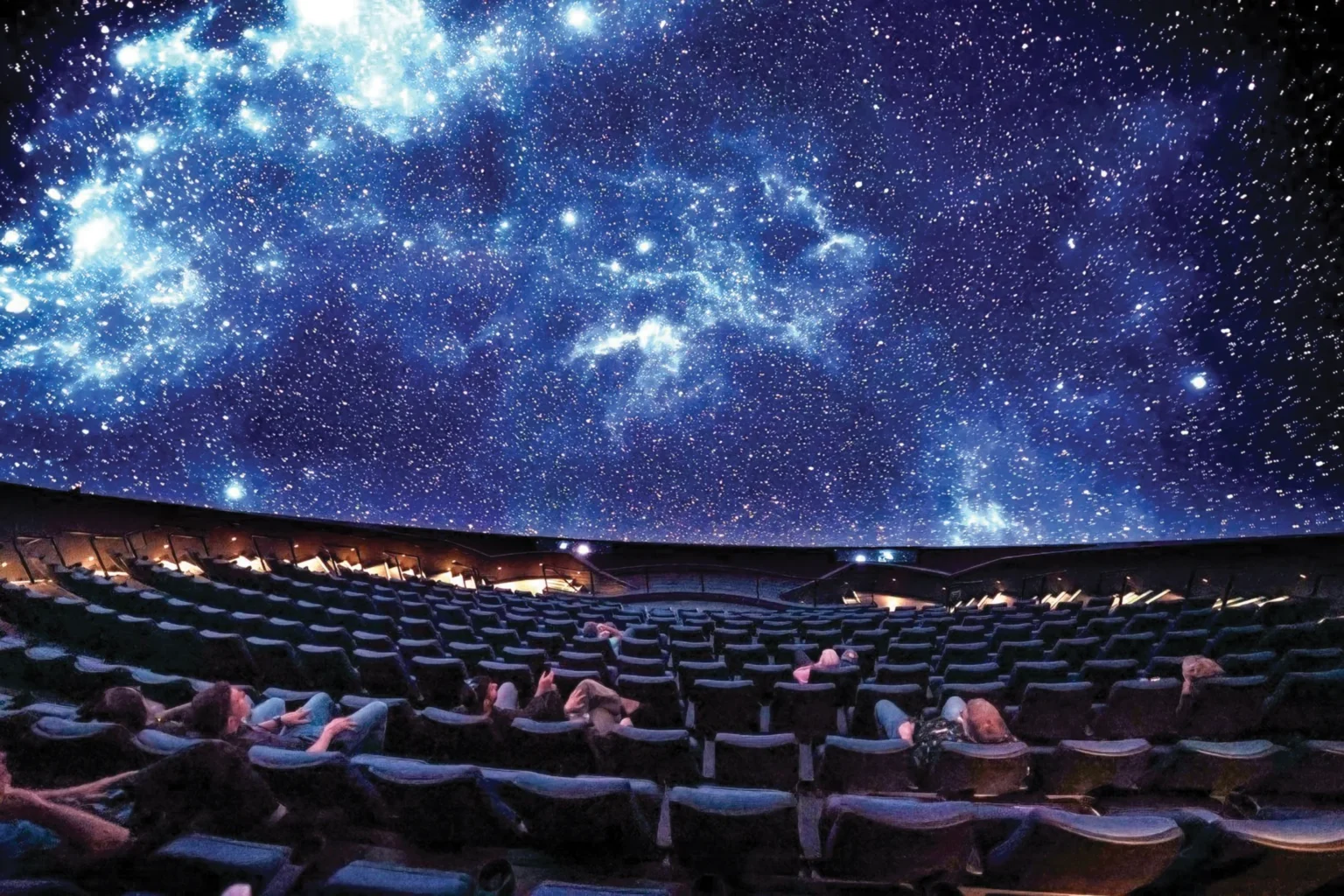
Ready to seek out strange new worlds and to go where no man (or woman) has ever gone before? Then check out the all-new Dome by Dr. Phillips Charities, which recently debuted at Orlando Science Center.
The Dome is a completely transformed immersive theater experience that boasts eight state-of-the-art laser projectors, 30,000 watts of surround sound, a near-seamless visual surface that spans 8,000 square feet, more abundant (and more comfortable) seating, and upgraded amenities certain to amaze and delight audiences.
Since 1997, OSC’s domed theater—previously known as the CineDome—had welcomed guests (all told, about 4 million of them) to view panoramic giant-screen films. It was all very mind-blowing 30 years ago, which is an eternity in the world of technology.
More recently, the venue had become dated and was one of the last museum theaters in the U.S. still showing old-school analog flicks. Now, after $7 million worth of upgrades, that’s certainly no longer the case.
“The Dome by Dr. Phillips Charities is a step forward in how we present storytelling that educates and inspires contemporary audiences,” says OSC President and CEO JoAnn Newman. “This environment will transport guests from the bottom of the ocean to the edge of the galaxy, creating unforgettable moments for all ages.”
The theater has also been physically redesigned, including removal of the former central projection structure to improve sightlines. A nearly seamless visual surface is created by 419 individual panels that provide maximum clarity, while a powerful 7.1 surround sound system delivers more than 30,000 watts of audio.
When you check it out, you’ll notice that the elevated experience begins before you even take your seat. A refreshed lobby features a dramatic LED wall and large-scale projection surfaces that surround you with motion, light and energy. Automated vending devices offer popcorn, candy and drinks.
The project was made possible through OSC’s “Unlock Science” campaign, which was bolstered by Dr. Phillips Charities—whose $1 million gift earned naming rights—as well as Orange County Arts and Cultural Affairs, The Bert W. Martin Foundation and The Magruder Foundation.
Their generosity has rocketed this aspect of the operation back to preeminence in the universe of science center planetariums, says Jeff Stanford, vice president of marketing at OSC.
“[The Dome] can take you to the edge of the galaxy and beyond,” he adds. “It can show you the night sky when you were born, or from your wedding day or the night sky over Orlando. It can transport you to the next solar eclipse.”
There’s so much more—but to understand the project’s significance, we must consider its history. When the first iteration of what would later become the science center opened in 1960, it was a museum of artifacts in the building that’s now home to Orlando Shakes.
The focus shifted to science in the early 1970s, when the facility was renamed the John Young Museum & Planetarium in honor of homegrown astronaut John Young. The building was expanded in the early 1980s and rebranded as Orlando Science Center. Notes Stanford: “The theater in the round at Orlando Shakes was our first planetarium.”
When OSC moved to its current location in Loch Haven Cultural Park, the state-of-the-art, 300-seat theater was its biggest attraction and showed an immersive array of educational documentaries, nature films and late-night laser light shows that became a local rite of passage.
The first four films to be seen in the new and improved theater, which will run in rotation for the foreseeable future, include Serengeti, Moonbase: The Next Step, T. Rex and Ocean Odyssey. Screenings are included with regular admission to OSC.
Music-themed laser light shows—like the one with a sound-track by Pink Floyd that packed ’em in here and everywhere else—will return. But because the technology has been upgraded, the musical choices available to OSC have expanded exponentially. (No offense to Pink Floyd, which still rocks, or to the band’s boomer fans.)
And that’s not all. In addition to showing movies, the new theater can host mixed-media events that combine live performances with animated or live-action images on-screen.
Projectors are connected to the internet, basically turning the screen into a massive web browser to accommodate anything from lectures by experts to student media presentations and “dome-casts” of content from other venues around the globe. Heck, if it chose to, OSC could even show the hottest new films from Hollywood.
“Dr. Phillips Charities is dedicated to the education and enrichment of our community and proud to further our legacy of support with this amazing venue,” says Ken Robinson, president and CEO of Dr. Phillips Charities. “We’re grateful to usher in its extraordinary next phase. The Dome will be a dynamic destination for wonder and discovery for generations of curious minds.”
Orlando Science Center is located at 777 East Princeton Street, Orlando, in Loch Haven Cultural Park. For more information, call 407.514.2000 or visit osc.org.
Enzian Theater
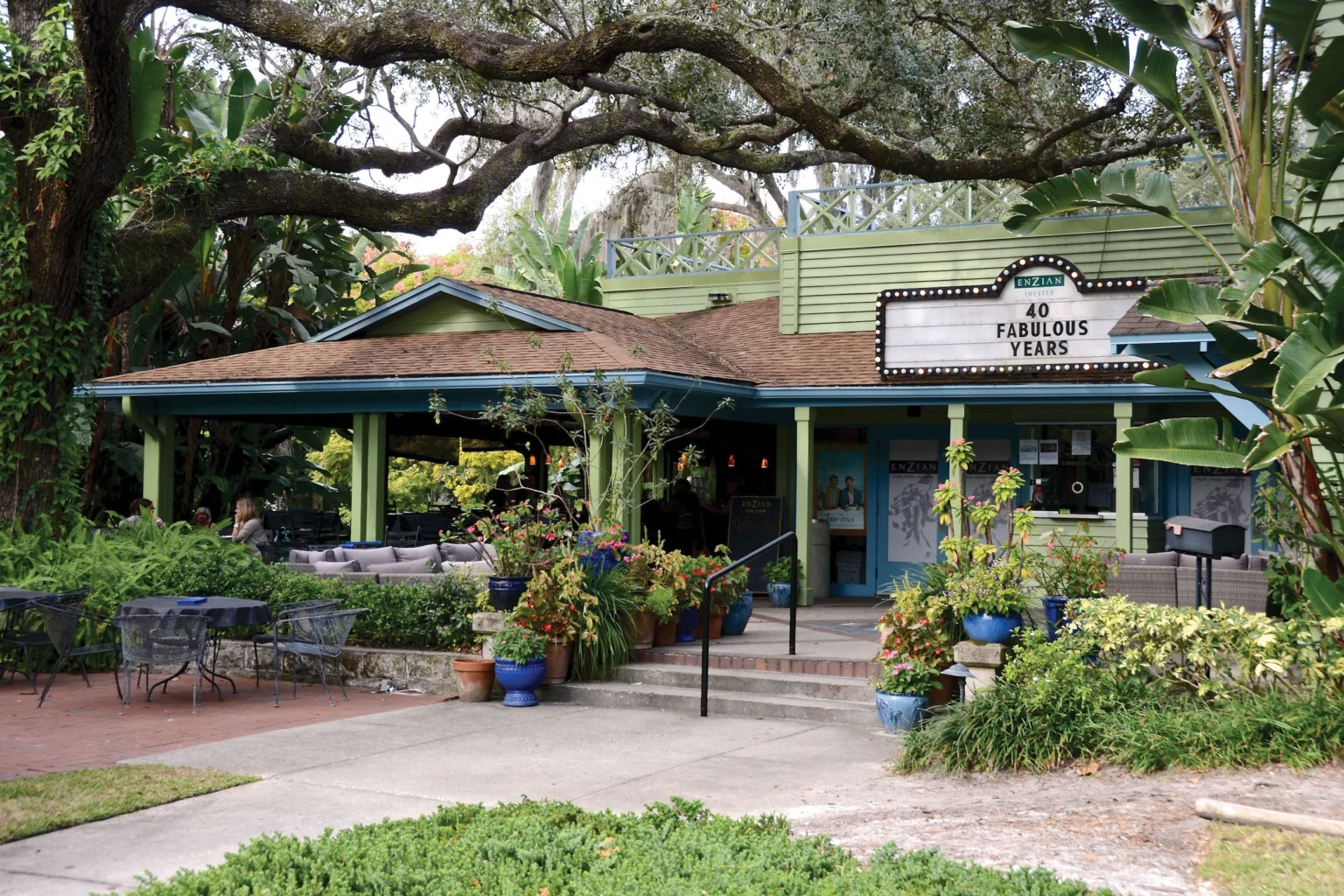
Enzian Theater’s executive director, Wade Neal, has only been in the job since last summer—realized the audiences who flocked to beloved art house cinema in Maitland were passionate about the place.
“Central Florida is very lucky because there aren’t a lot of places like this in the world,” says Neal. “[Enzian] has an artistic strength to it that is really built around the audience that supports it.”
Now, with the support of the audience and donations, Enzian has upgraded one of its most critical features: its film projector. Donations during a 40th anniversary capital campaign last year quickly raised the $150,000 needed to install a state-of-the-art, reel-to-reel system capable of screening both 35mm and 70mm films.
The highly anticipated feature film debut of this custom-designed equipment was a 70mm screening of Christopher Nolan’s all-star epic The Odyssey in July. Up until then, Enzian had shown movies on 35 mm prints, both current releases and its regular series of Cult Classics.
“We sold out multiple screenings of The Odyssey,” says Neal. “Audiences are drawn to the special warmth, the richness of color and the depth of movies on film. These screenings bring the romance of analog and physical, tangible art to the screen in a beautiful way.”
Over the past few years, 70 mm has become more popular with mainstream filmmakers, including Nolan, whose Best Picture–winning Oppenheimer was shown in 70 mm. Last year, such blockbusters as Sinners and One Battle After Another were also shown in the larger frame format.
Seeing a film projected in 70mm does indeed provide an elite cinematic experience that standard digital or 35mm formats can’t match. Because the physical film frame is twice as wide as standard 35mm, it offers a canvas with vastly superior visual and structural qualities. And Enzian is now one of the few indy outfits in the country that has the technology required.
But wait, there’s more! The cozy theater has also recently installed a next-generation screen and an upgraded 7.1 sound system—an eight-channel surround sound setup that wraps audio completely around you using eight distinct speakers.
“Enzian is already recognized as one of the leading independent cinemas in the country,” says Matthew Curtis, programming director. “The addition of this new equipment will be an absolute game changer, bringing the theater’s projection to a level of excellence that will enthrall cinephiles and casual moviegoers alike.”
No doubt, Enzian is no strip-mall multiplex. It’s one of Central Florida’s most cherished cultural landmarks—one that resembles an understated country club more than a movie house, with an outdoor restaurant situated beneath towering live oaks and an intimate, cabaret-style theater just inside.
Enzian is a nonprofit organization that was founded by the family of the late John M. Tiedtke, a philanthropist who for decades ran (and mostly funded) the Bach Festival Society of Winter Park. Tiedtke famously said he wasn’t a big fan of movies but was persuaded to back the project by the determination of his daughter, Tina, to make it a reality.
The theater’s interior was remodeled several years ago and configured so that patrons can order libations from their table instead of previous beer-and-wine-only selections.
The refreshed lobby and its new bar were playfully named “Keen’s Purgatory” in honor of board member and donor Alan Keen and his wife, Linda. And the outdoor Eden Bar has become one of the area’s premier hangouts whether you’re there to watch a movie or not.
The big event at Enzian is the Florida Film Festival, which brings dozens of the world’s best independently produced new features, documentaries, animated films and shorts to Central Florida every April. It’s a qualifying festival for the Oscars in three short-film categories: Live Action, Animation and Documentary.
On a more modest level, Enzian partners with the City of Winter Park to present its “Popcorn Flicks in the Park” series on the second Thursday of each month in downtown Central Park. The family-friendly flicks typically start at 7 or 8 p.m., depending upon when the sun sets.
Neal—who came to Enzian from Tacoma, Washington—was assistant executive director of both Tacoma’s Grand Cinema and the well-regarded Tacoma Film Festival. But he was attracted to Enzian, he says, because people here seemed to love the place so much.
He adds: “What’s going on here is stunning. When we play a classic film on a Saturday morning, we often have 100 or 200 people. It’s just an incredible place that everyone should know about.”
To Neal—a fan of films by David Lynch, the Cohen brothers and Martin Scorsese—good movie houses are important cultural hubs: “I think it’s really important to have places like that in our world where we can gather and that can glue us together over something as beautiful as film.”
Enzian is located at 1300 South Orlando Avenue, Maitland. For hours or a film schedule, call the information line at 407.629.0054 or the theater offices at 407.629.1088. More information is available at enzian.org.
The Holocaust Memorial Resource & Education Center
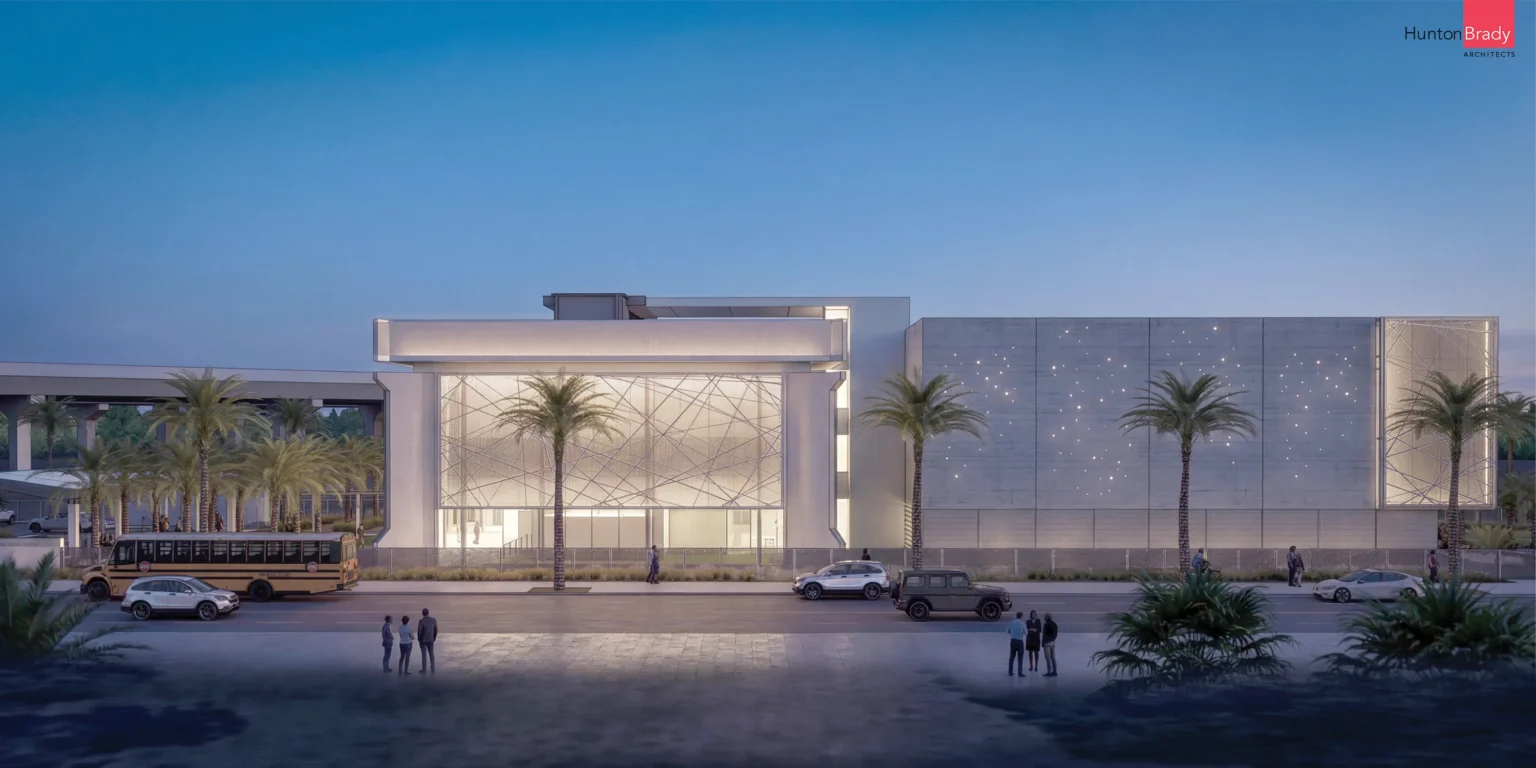
The Holocaust Memorial Resource & Education Center of Florida in Maitland has secured gifts and pledges surpassing 70 percent of its funding goal—more than $44 million of the
$63 million sought—to retrofit, expand, operate and endow a reimagined Holocaust Museum for Hope & Humanity in Orlando.
“We’re proud to have landed on a rightsized concept that strengthens our vision,” says Ronald Schirtzer, board chair. The design, he adds, “dramatically expands our ability to deliver programs within and beyond the museum’s walls, and establishes the financial foundation to sustain this mission for generations.”
A previous iteration of the plan had called for a 44,500-square-foot complex to be built on the site at 75 South Ivanhoe Boulevard. Now, however, the existing three-story building—designed in 1968 by legendary Florida modernist master Nils Schweizer—will be adapted by Orlando-based HuntonBrady Architects.
You likely know the brick-and-glass mid-century landmark, which for years housed the Orlando Regional Chamber of Commerce. It measures 13,620 square feet and will get a 14,580-square-foot addition. The resulting 25,345-square-foot structure will be 3.5 times larger than the current space in Maitland.
Plans call for the new wing to encompass the core exhibition, Hope & Humanity, which “invites visitors to move alongside local survivors and encounter events as they were experienced and understood in real time,” says Suzanne Grimmer, senior director of museum experiences.
Advanced AI will interpret questions asked by visitors, who’ll then be answered by interactive holograms of survivors who had previously videotaped answers to perhaps 1,000 questions. “It will be your neighbors,” adds Grimmer, who notes that most interview subjects were Floridians and many were Central Floridians.
Some of those answers will be harrowing to hear—but the resilience of the human spirit will be confirmed when you learn that many survivors, despite what they endured, went on to lead productive, even noble, lives.
MDSX, an Orlando-based experience design, media production and creative management agency, will spearhead exhibition design for the museum—where the narrative power will come from lived moments, emotional truths and human connections rather than the more traditional perpetrator-oriented timelines.
“You’ll see [survivors] more fully as individuals,” notes Stephen Poynor, senior director of education and community engagement, of this philosophy. “You see their lives before, during and after. You see them as having had an impact on our community rather than just as having been victims of the Holocaust.”
That survivor-centric narrative approach will be reflected on the exterior of the building, which will be covered by a semi-transparent exterior metal screen that will be backlit to create a twinkling starlight effect and to symbolize the diaspora of those who emerged alive, if not unscathed, from the most horrific campaign of terror in human history.
“More than just a destination, the Holocaust Museum for Hope & Humanity will help residents and visitors learn from the past as we work to ensure that our city remains welcoming to all people today and tomorrow,” says Orlando Mayor Buddy Dyer. “I’m grateful for collective support of the center as it works to bring this vision to reality.”
The city, which owns the building, is doing its part by giving the museum a 50-year lease at $1 per year because of its value as a major educational and cultural resource.
The project—which will also encompass traveling exhibition space, classrooms and community meeting facilities—is funded by $10 million from the Orange County Tourist Development Tax as well as $5 million from the Florida Legislature and numerous gifts from foundations and individual donors.
At press time, the center had just hired a new executive director to lead it through this pivotal time. Tim Roberts, who will start his new job in early September, is a Florida native who is coming to the center from Long Beach, California, where he was executive of the Rancho Los Alamitos Historic Ranch and Gardens.
Robers has taught history at the University of West Florida, his alma mater, and served as deputy director of the New Mexico Department of Cultural Affairs Historic Sites Division. ”I have spent the last 20-plus years of my career working in the sphere of marginalized and traumatic history,” Roberts told the Orlando Sentinel.
The museum likely won’t be ready to open before early 2028. In the meantime, you can visit the current facility at 851 North Maitland Avenue, Maitland, on the campus of the Roth Family JCC. For more information, call 407.628.0555 or visit hmrec.org.
Bragging Rights
Orlando Museum of Art
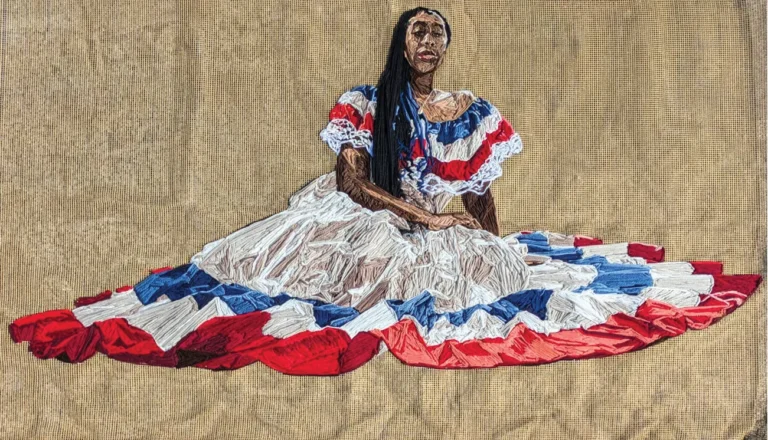
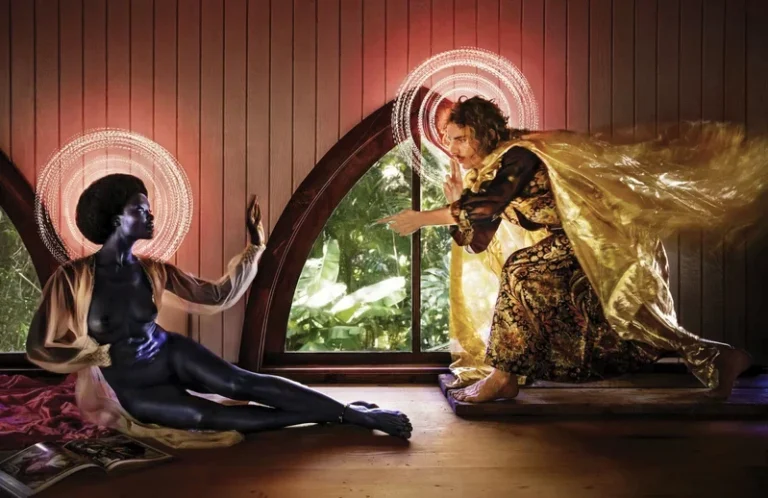
And the good news just keeps on coming, as Orlando Museum of Art recently acquired two fan favorites for its permanent collection. The resurgent museum now owns Hispaniola II – Mia by Kandy G. Lopez, which won the People’s Choice vote during the 2025 Florida Prize in Contemporary Art, and Annunciation, Hawaii by David LaChapelle. | Courtesy Orlando Museum of Art
Central Florida’s premier legacy arts institution has officially turned the page on a challenging era. Orlando Museum of Art’s probation with the American Alliance of Museums (AAM) has ended and full accreditation has been restored.
This solidifies the institution’s comeback from a nationally publicized scandal that erupted in 2022 after the FBI seized artwork attributed to the late Jean-Michel Basquiat from an OMA exhibition titled Heroes & Monsters.
A California man later admitted to forging some of the works, although out-of-state owners have insisted they are genuine.
AAM imposed the rarely used penalty following the raid, which made national and international news. For a time, the action seemed to threaten the museum’s viability even as it neared its 100th anniversary in 2024.
Only about 3 percent of the nation’s museums meet the rigorous accreditation standards, which demonstrates OMA’s lofty stature in the museum world prior to the debacle with the Basquiats.
The reaccreditation—which is valid for the next 10 years—affirms that the institution once again meets the highest standards of excellence in governance, collections, stewardship, education and community service.
The AMA accreditation document reported that “courageous and ethical leadership, dedicated trustees, clear planning and training in best practices have put the Orlando Museum of Art on a healthy trajectory.”
Management of the museum changed entirely following the upheaval, including a new executive director, Cathryn Mattson, previously a corporate and nonprofit executive and a certified leadership coach; and a new chief curator, Coralie Claeysen-Gleyzon, previously OMA’s associate curator who had raised red flags about the authenticity of the Basquiats.
The board and its leadership also changed entirely, all of which combined to stabilize the institution’s finances and led to massive attendance increases. In addition, for the third year in a row, OMA received the largest donation ever—$575,000—from its volunteer fundraising committee, the Council of 101. The council’s signature fundraising events are the holiday Festival of Trees and the springtime event Art in Bloom.
“Year after year, the Council of 101 demonstrates what’s possible when creativity, service and community come together in support of the arts,” says Mattson. “We are incredibly grateful for this historic gift, which will help OMA continue presenting meaningful exhibitions, expanding educational programming and creating welcoming experiences for audiences of all ages.”
And the good news just keeps on coming, as OMA recently acquired two fan favorites for its permanent collection.
Following its David LaChapelle: As the World Turns exhibition, OMA announced the gift of Annunciation, Hawaii from the renowned photographer. In addition, the OMA Acquisition Trust Group purchased Hispaniola II – Mia by Kandy G. Lopez, which won the People’s Choice vote during the 2025 Florida Prize in Contemporary Art.
Meanwhile, renovation work on OMA’s 66-year-old headquarters continues apace. The $7 million project is being funded by state and county grants as well as private donations and includes exterior renovations, a new roof and a new air-conditioning system.
Behind-the-scenes systems are likewise getting upgrades, thanks to a recent $50,000 grant from the Edyth Bush Charitable Foundation. Three disconnected systems—Customer Relations Management (CRM), point-of-sale and financial management—will soon be combined into one integrated platform.
“This generous grant is an investment in the work that keeps OMA running and growing for its visitors,” adds Mattson. “Modernizing our technology infrastructure will help us better serve our guests, deepen relationships with our members and donors, and manage our resources.”
OMA is located at 2416 North Mills Avenue, Orlando, in Loch Haven Cultural Park. For more information, call 407.896.4231 or visit omart.org.