
Talia Blake, host of Central Florida Public Media’s Morning Edition on 90.7 FM in Orlando, grew up listening to public radio, she says, as “a back-seat kid.” Her father was an avid fan of the thoughtful news roundup and its anchors Robert Siegel, Michele Norris and Melissa Block.
The only child of Jamaican immigrants who believed in the importance of being well-informed and whose mantra is “you don’t know what you don’t know,” Blake majored in journalism at the University of Central Florida and was thinking of a career in commercial television news, not public broadcasting.
That is, until she couldn’t get an internship. Her father suggested that she try the local National Public Radio affiliate, and she soon found herself working as an intern on 90.7 FM’s Intersection.
There, Blake fell in love with public broadcasting, its independence, and its range of content. But she distinctly remembers: “I have a lot of friends who literally didn’t know what public media was until I got this job.”
Therein lies the challenge in a world in which media—print, broadcast and social—has experienced seismic changes. Who is the next generation of listeners? Where will tomorrow’s public media reporters and editors come from?
Central Florida Public Media has intensified its outreach to aspiring journalists in the last few years. Its hope is to reel them into the cause through an immersive experience in public media’s nonprofit style of journalism.
LaToya Dennis, news director and managing editor, holds bachelor’s and master’s degrees in journalism from Michigan State University and was converted to public media working at an East Lansing public radio station in graduate school.
“Most people in journalism school don’t think about public media as an option. We want to change that,” she says. “We are screaming loudly, ‘Hey, we’re here. Here’s how we work, here’s what we do, here’s what we are about. We are mission driven.’”
The high point of the strategy was the creation of a year-long fellowship for a qualifying young journalist. Luis-Alfredo Garcia, a graduate of the University of Florida’s journalism school, was selected from almost 70 applicants as the first recipient for Central Florida Public Media’s Emerging Journalist Fellowship.
His invaluable experience at 90.7 FM from August 2024 to August 2025 won him a job as a reporter at South Carolina Public Radio. He has recently been heard on NPR broadcasts with reports on the measles outbreak in the Palmetto State.
Garcia, like Blake, was a University of Florida journalism major. Also like Blake, he hadn’t envisioned himself in public media—his interest was in digital and print media—but the opportunity for a paid fellowship was irresistible and he applied. At 90.7 FM, he says, “Not only did they accept my presence, they also embraced it.”
He shadowed reporters, studied news scripts and learned to write like he was talking to someone. He especially enjoyed the freedom and the encouragement to go after stories in underrepresented communities. A feature story he produced about a community group working to restore a Black cemetery—“Saints, Sinners and Saviors”— can still be found online.
All of these experiences, he says, “really built up my trust in public media.” He learned to appreciate not only the responsibility of the job but the intimacy of the medium as well. “If you’re listening to a story in the car, or listening to the audio on the web, then you really have somebody right in your ear telling you a story,” he says.
The news team at 90.7 FM was set to bring in another fellow, having selected three finalists from 112 applicants, when they were faced with a budget crisis. Last year, the federal government cut $300,000 in funding and the State of Florida cut another $100,000. For now, the fellowship that they hoped would be awarded annually awaits new sources of funds.
Central Florida Public Media’s $5 million annual budget is largely supported by memberships, corporations, foundations and underwriters. For the second year, it’s participating in United Arts of Central Florida’s collaborative campaign.
Public media locally has a long history of surviving financial vicissitudes. It began with WMFE-TV in 1965 and was expanded with the launch of WMFE 90.7 FM in 1980. The television station was sold in 2012 to UCF and the radio station went solo until acquiring WSKG 89.5 FM in Marion County.
Then, in 2024, WMFE and WSKG were renamed and rebranded as Central Florida Public Media. “Radio isn’t just radio anymore,” notes Dennis. “We’re multimedia now.”
The organization’s programs and reports, including such NPR drive-time classics as Morning Edition and All Things Considered, can be heard on the radio, on the web, on podcasts and some programs feature video on social media. Don’t have time for that? Sign up for the weekly e-newsletter, The Wrap, for top stories.
Says Dennis: Radio is “still our strongest medium, however, what we know is if you want to reach younger more diverse audiences, which is critical, you have to meet them where they are.”
To continue bringing recruits into this multimedia environment, Central Florida Public Media supports one to two interns from UCF’s journalism school each semester. This spring, the newsroom has one production intern working with the space exploration show and podcast Are We There Yet? and a newsroom intern producing stories on the upcoming midterm election.
“Students cover real news and produce work that they are proud to display in their graduation portfolios,” says Rick Brunson, UCF senior instructor at the Nicholson School’s Film and Mass Media program.
Four years ago, 90.7 FM created a partnership with UCF for a series called Sounds of Central Florida. The electronic journalism students pitch story ideas, some of which are selected to be produced. At the end of the semester, 90.7 FM airs the stories that measure up.
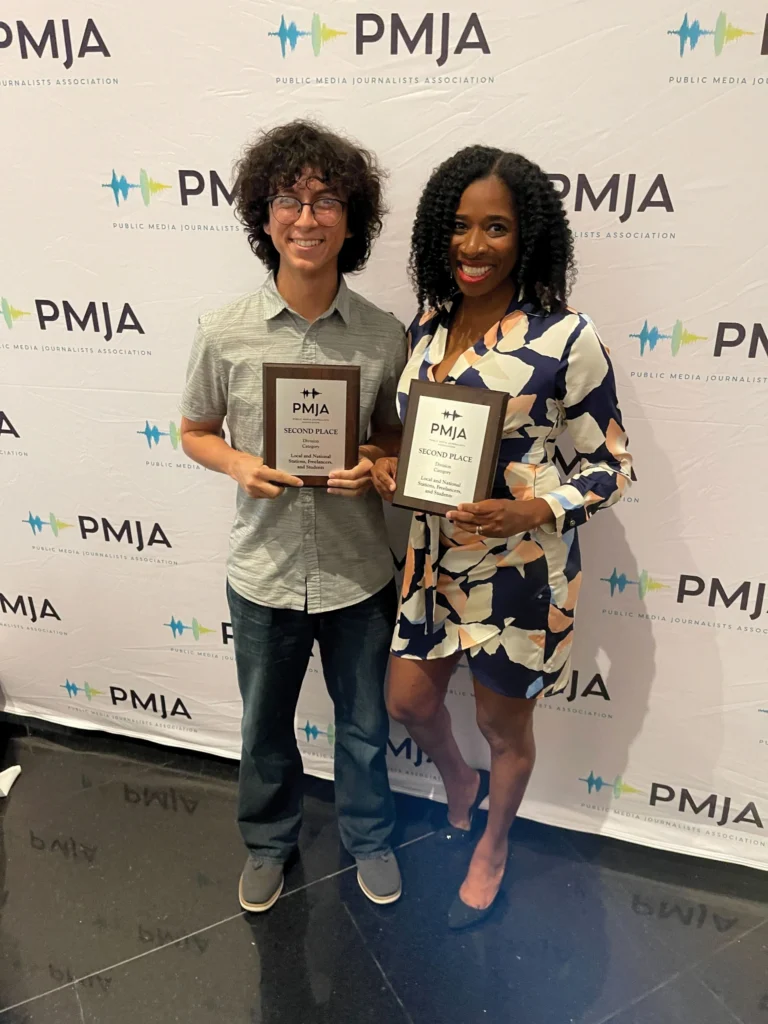
These stories have won multiple statewide journalism awards, including from the Florida Association of Broadcast Journalists, adds Brunson.
College students aren’t the only target for enlightenment. Royal McHenry, a staffer on Boone High School’s newspaper, has worked two summers at 90.7 FM as its first high school intern.
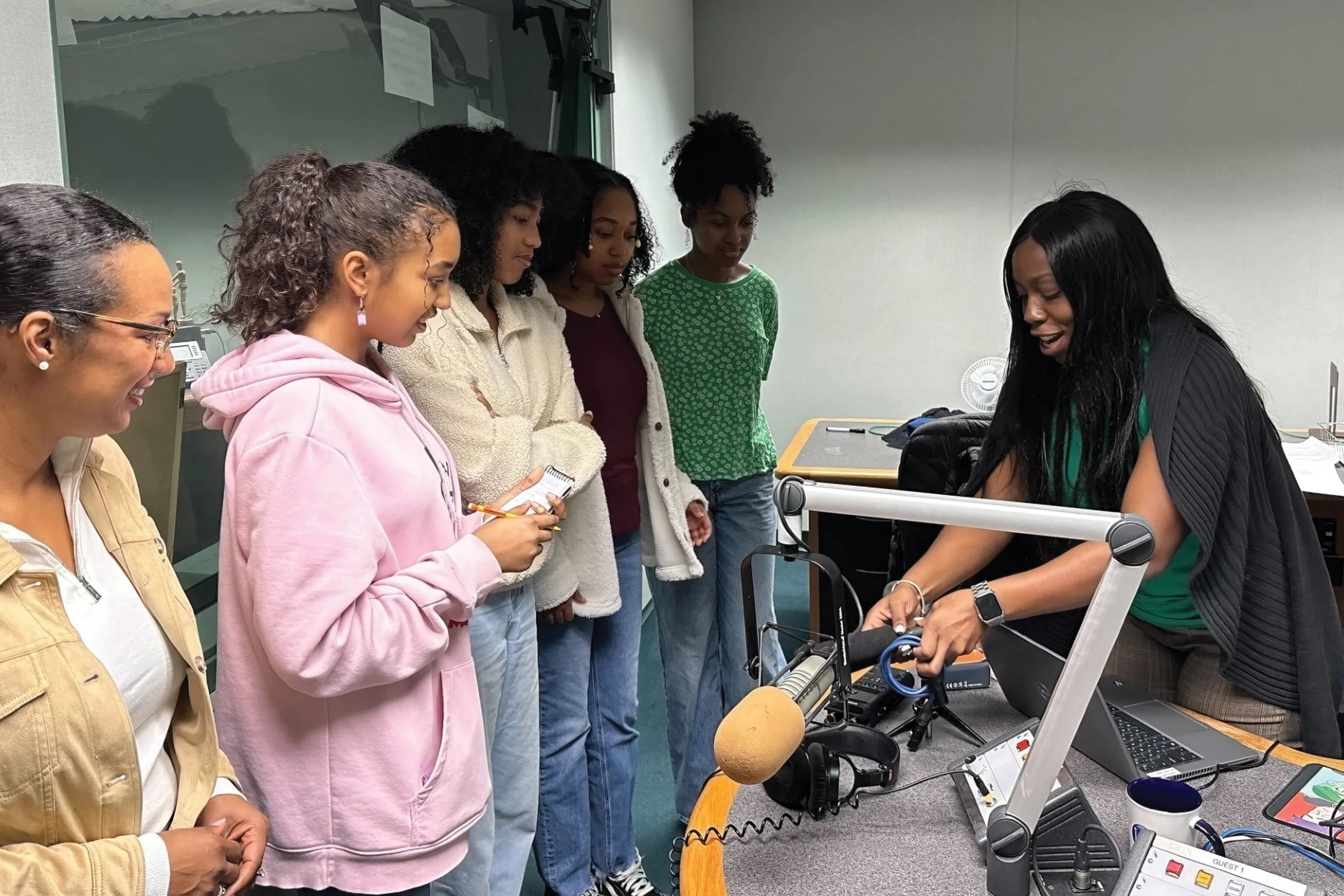
Blake, in her passion for being a “megaphone” for public media, presents programs about her job at the New Image Youth Center in Parramore. She also helps coach high school students at the Rollins College student-run radio station, WPRK 91.5 FM, when they visit as part of the college’s program for disadvantaged youth, Upward Bound.
“I always feel reinvigorated after I’ve talked with a group of kids,” says Blake. They could indeed be part of the next generation of news soldiers at Central Florida Public Media.